Frap Tools, the Italian maestros of modular design, present CUNSA—a quadruple multimode analog filter module that’s far more than just a filter. In this in-depth tutorial, the Frap Tools team dissect CUNSA’s core features, from classic lowpass sweeps to saturated resonance and pingable envelopes, all while revealing the module’s knack for parallel processing and organic sound shaping. If you’re after a filter that morphs from subtle seasoning to full-bore oscillator, and want to know how it actually patches up in a real rack, this video is a must-watch. Let’s see how CUNSA’s four filters, clever routing, and voltage control options can transform your modular workflow.
3. April 2024
MILES
Frap Tools CUNSA: Quadruple Filter Alchemy in Eurorack
Frap Tools 333, Frap Tools Brenso, Frap Tools CGM, Frap Tools Cunsa, Frap Tools Falistri, Frap Tools Sapèl
Seasoning the Sound: CUNSA’s Introduction
Frap Tools introduce CUNSA as their so-called “sound seasoning tool,” but that’s underselling it. At its core, CUNSA is a quadruple mono—or double stereo—pingable multimode resonant filter, but it also moonlights as a saturator, mixer, and even an oscillator. The design isn’t just about stacking four filters; each filter can be coaxed into wildly different sonic roles, making the module a veritable Swiss Army knife for the modular enthusiast.
Each of CUNSA’s four analog filters offers lowpass, bandpass, and highpass outputs, with the lowpass filter switchable between 12 dB and 24 dB per octave slopes. Combined outputs and semi-normalled inputs hint at a module that wants to be patched in creative, interconnected ways. This opening segment sets the stage for a deep dive into how a single filter behaves before the video explores the more complex multi-filter territory.

"Pingable multimode resonant filter, saturator, mixer and oscillator, ultimately it is a filter, but we prefer to say that it is like multiple filters and not just because there are four of them."
© Screenshot/Quote: Fraptools (YouTube)
Cutoff, Q, and Character: Sculpting the Filter
"The character knob defines what the filter does when overloading, so by default when it is set all the way to the left it will have a sort of safety circuit that adds some soft clipping, it is very smooth and we actually modeled it over the CGM."
© Screenshot/Quote: Fraptools (YouTube)
The video quickly moves to the bread and butter of filter operation: cutoff frequency, resonance (Q), and the intriguingly named Character parameter. Cutoff and input VCA are straightforward, but the Q knob—akin to resonance or emphasis—lets you dial in anything from subtle contouring to pronounced peaks at the cutoff frequency. Notably, CUNSA’s lowpass filter retains its bass presence even at high Q, sidestepping the dreaded thinness that plagues some designs. Adjusting input level further shapes the tone, from clear and open to tightly focused.
The Character knob is where things get spicy. This control determines how the filter circuit behaves when pushed—at its lowest setting, you get a soft-clipping safety circuit modeled after Frap Tools’ CGM mixer, while cranking it up removes these protections, inviting more aggressive saturation. The interplay between Q and Character yields a spectrum of filter behaviors, from clean resonance to wild, distorted screams. Oscilloscope views reveal how Character warps waveforms, especially when the filter is overloaded, and how these changes differ between 12 dB and 24 dB slopes.
Parallel Worlds: Combining Filters for Complex Textures
After establishing the basics, the tutorial demonstrates how CUNSA’s four filters can be combined for intricate sonic results. Thanks to semi-normalled connections, patching a signal into one filter input can cascade it across all four filters, opening up parallel processing possibilities. The module’s mixing section provides summed outputs for pairs of filters or all four at once, allowing users to blend and sculpt layers of filtered sound.
Each filter can be set to a different mode—lowpass, bandpass, or highpass—and tweaked individually for Q and Character. This flexibility enables phasing effects, complex stereo images, and dynamic textures that would otherwise require a tangle of modules. The video shows how external CV sources can modulate amplitude or transpose all filters simultaneously, and how spreading filter frequencies creates lush, animated soundscapes. The ability to ping or modulate filters independently or in groups further expands the creative palette.
Beyond Filtering: Self-Oscillation and Pinging Circuits
CUNSA isn’t content to just filter—its high Q settings let each filter self-oscillate, turning them into sine wave oscillators that track volt per octave quite respectably. The tutorial showcases how different filter outputs (lowpass, bandpass, highpass) yield distinct oscillator timbres, and how the fine-tune knob allows precise pitch control. There’s even a bonus tip: pairing CUNSA with Frap Tools’ Brenso enables true zero FM patches, effectively creating a pair of complex oscillators from what started as a filter module.
The video also explores CUNSA’s ping circuit, a custom-designed, nonlinear integrator that generates organic, falling envelopes from triggers or CV sources. This pinging is DC-coupled and sensitive to amplitude and duration, making it more versatile than typical filter pings. The combo mode shines here, linking cutoff and VCA for natural, decaying envelopes—ideal for percussive or plucked sounds. The distinction between filter pinging and filter ringing is clarified, underscoring CUNSA’s flexibility in both classic and experimental patching.

"I'm giving you a free tip right now because having these many sine waves that track this good with that true 0fm oscillator like the brain saw means that you can use brain saw as a double true 0fm oscillator."
© Screenshot/Quote: Fraptools (YouTube)
Patch Bay Playground: Routing and Semi-Normalled Connections

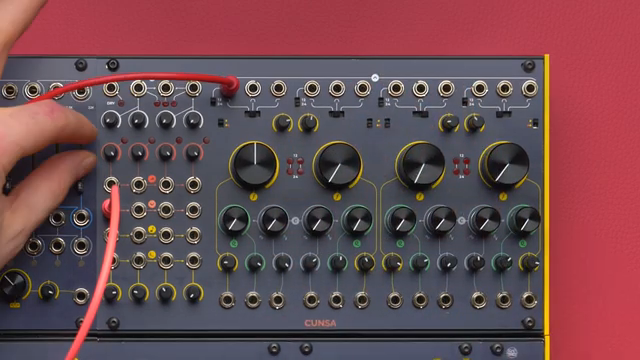
"Also feeds all the input towards its right in a semi-normal connection which means that this signal which is now going into filter one is going to into filter two, three and four."
© Screenshot/Quote: Fraptools (YouTube)
The tutorial wraps up by spotlighting CUNSA’s routing options and semi-normalled connections, which are central to its creative workflow. Any signal patched into an input is automatically routed to all filters to its right, making parallel processing and stereo setups a breeze. The mixed outputs allow for various combinations—filters 1+2, 3+4, or all four—while routing switches let users select which filter mode is sent to the mix.
This flexibility means CUNSA can serve as four independent filters, two stereo pairs, or a single, complex filter bank. The dry output sums pre-filter VCA signals for parallel processing, and its behavior is shaped by combo mode and modulation sources. The video closes with patch examples that combine filtering, pinging, and mixing, demonstrating how CUNSA integrates into larger modular systems and rewards adventurous patching.
This article is also available in German. Read it here: https://synthmagazin.at/frap-tools-cunsa-vierfach-filter-alchemie-im-eurorack/
Watch on YouTube:
Latest articles
Watch on YouTube:
Visit the channel:
https://www.youtube.com/FrapTools
https://www.youtube.com/FrapTools
Links from FrapTools:
website: https://frap.tools
instagram: https://instagram.com/fraptools
facebook: https://www.facebook.com/fraptools
twitter: https://twitter.com/fraptools
soundcloud: https://soundcloud.com/fraptools
Sponsored links:
If you purchase via these links, we may earn a small commission – at no extra cost to you. The link opens an Amazon keyword search, and results may vary depending on availability.
Frap Tools 333
🔗 Check price on Amazon
🔗 Check price on Amazon
Frap Tools Brenso
🔗 Check price on Amazon
🔗 Check price on Amazon
Frap Tools CGM
🔗 Check price on Amazon
🔗 Check price on Amazon
Frap Tools Cunsa
🔗 Check price on Amazon
🔗 Check price on Amazon
Frap Tools Falistri
🔗 Check price on Amazon
🔗 Check price on Amazon
Frap Tools Sapèl
🔗 Check price on Amazon
🔗 Check price on Amazon