Frap Tools delivers a masterclass in modular counterpoint with Francesco Gennari’s performance of ‘Studio No. 5’, where analog and digital timbres collide in a carefully orchestrated patch. This video isn’t just a performance—it’s a deep dive into the mechanics of cross-FM, voice layering, and the subtle art of modular composition. With a rig built around Brenso, Hertz Donut MK1, and a host of supporting modules, Gennari demonstrates how to weave three independent voices into a coherent, evolving narrative. Expect a blend of technical insight, patching tricks, and a clear-eyed look at how different synthesis techniques interact within a Eurorack ecosystem.
13. August 2025
MILES
Frap Tools: Counterpoint and Cross-FM – A Modular Dialogue in Studio No. 5
Desmodus Versio, Disting EX, Doepfer Low Pass Gate, Frap Tools 321, Frap Tools 411, Frap Tools Bagài, Frap Tools Brenso, Frap Tools Falistri, Frap Tools QSC Mixer, Frap Tools Sapèl, Frap Tools USTA, Hertz Donut MK1, Optomix, SEM VCF
A Modular Étude in Counterpoint
Francesco Gennari opens the session with a performance of ‘Studio No. 5’, a piece rooted in the tradition of the étude—each track serving as a focused investigation into sound, structure, and technique. The central theme here is counterpoint, not just as a compositional device but as a guiding principle for the entire patch. Gennari’s approach is to let three independent voices interact and evolve, each with its own timbral identity, creating a dialogue that unfolds gradually rather than all at once.
The performance itself is a showcase of restraint and sonic exploration. Voices emerge one after another, overlapping and receding to reveal new textures and harmonic relationships. This gradual layering is key to the narrative, as the interplay between analog and digital sources becomes the engine driving both the harmonic and textural development. Frap Tools’ penchant for detailed, design-driven modular work is evident from the outset, with every element serving a clear role in the unfolding musical journey.
Three Voices, Three Worlds: Anatomy of the Patch
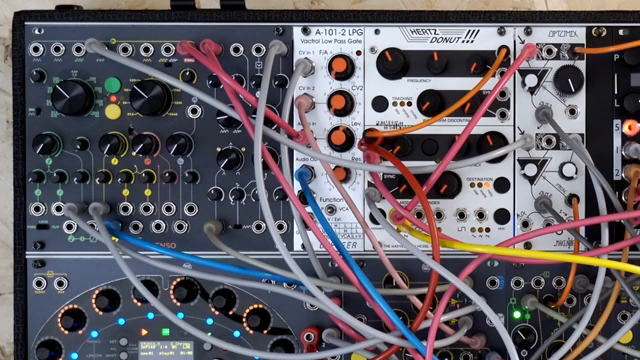
At the heart of the patch are three distinct voices, each crafted from a different synthesis approach and module combination. The first voice is built around the Frap Tools Brenso complex oscillator paired with a Doepfer low pass gate, delivering the kind of analog cross-FM timbres that Brenso excels at. The second voice introduces a digital contrast via the Hertz Donut MK1, routed through an Optomix, while the third voice employs Falistri as an audio-rate source, filtered by a SEM VCF for a more classic, modulated tone.
Each voice is sequenced independently, with careful attention paid to their entry points and development. The Brenso voice is controlled by Usta’s Track 1, the Hertz Donut by Track 2, and the Falistri voice by Track 4. Effects are distributed across the voices, with Disting EX handling ping-pong delay and reverb, and Desmodus Versio providing a lush, expansive tail in the track’s final moments. The QSC mixer acts as the central hub, blending these elements into a cohesive whole while allowing for dynamic spatial placement and level control.
Cross-FM and Modulation: Sculpting Complexity
A defining feature of this patch is the use of cross-FM synthesis, particularly in the Brenso and Hertz Donut voices. Gennari demonstrates how true zero FM on Brenso allows for intense modulation while maintaining melodic clarity—a crucial consideration when layering complex voices. Both oscillators in Brenso are tuned to each other, with cross modulation amounts carefully set using Sapèl’s random voltages and manual attenuators. This approach enables evolving timbral complexity without sacrificing the intelligibility of the melodic line.
On the digital side, the Hertz Donut MK1 is set up for a lighter cross-FM effect, with modulation depth controlled via the Frap Tools 321 and 411 modules. Here, wave shaping and discontinuity are used to push the digital oscillator into more aggressive territory, but always with an ear towards contrast and balance. The interplay between analog and digital FM techniques is not just a technical exercise—it’s the backbone of the piece’s sonic identity, providing both grit and clarity in equal measure.
"I really love the sound of the cross FM on the Brenso, but to get a result that maintained melodic clarity (true zero FM helps with this), I did some testing and found a couple of useful tricks."
© Screenshot/Quote: Fraptools (YouTube)
Layering and Interaction: Building the Narrative
Layering is central to Gennari’s compositional workflow. As the track progresses, voices are introduced, withdrawn, and transformed, often through subtle changes in modulation or effects routing. For example, when the primary Brenso voice fades, a secondary layer is created using the SO output from Brenso’s green oscillator, routed through Optomix and modulated for rhythmic variation. This keeps the melodic thread alive even as the timbral focus shifts.
The interaction between voices is further enhanced by clever use of random voltages and sample-and-hold signals from Sapèl and Bagài. These modulations affect everything from FM depth to panning, ensuring that no two repetitions are quite the same. The result is a living, breathing patch where each element responds to both compositional intent and generative processes, reflecting Frap Tools’ philosophy of modular design as an invitation to explore rather than a fixed recipe.
Effects and Ambience: The Final Polish
No modular performance is complete without a considered approach to effects, and here the integration is both functional and creative. Disting EX is pressed into service for both ping-pong delay and reverb, with each effect receiving its own aux send from the QSC mixer. This allows for precise spatial placement and dynamic control over the wet/dry balance, crucial for maintaining clarity in a dense patch.
Desmodus Versio is reserved for the track’s final section, where its long reverb tail expands the sonic space and marks a clear transition in the narrative. Gennari even demonstrates a workaround for limited mute buttons by using a VCA from the 411, opening it via a programmed gate sequence from Usta. This kind of patching ingenuity is emblematic of the modular ethos: when the system runs out of obvious solutions, there’s always another way to reroute, repurpose, or reimagine the signal flow.
This article is also available in German. Read it here: https://synthmagazin.at/frap-tools-kontrapunkt-und-cross-fm-ein-modulares-gespraech-in-studio-no-5/
Watch on YouTube:
Latest articles
Watch on YouTube:
Visit the channel:
https://www.youtube.com/FrapTools
https://www.youtube.com/FrapTools
Links from FrapTools:
website: https://frap.tools
instagram: https://instagram.com/fraptools
facebook: https://www.facebook.com/fraptools
twitter: https://twitter.com/fraptools
soundcloud: https://soundcloud.com/fraptools
Sponsored links:
If you purchase via these links, we may earn a small commission – at no extra cost to you. The link opens an Amazon keyword search, and results may vary depending on availability.
Desmodus Versio
🔗 Check price on Amazon
🔗 Check price on Amazon
Disting EX
🔗 Check price on Amazon
🔗 Check price on Amazon
Doepfer Low Pass Gate
🔗 Check price on Amazon
🔗 Check price on Amazon
Frap Tools 321
🔗 Check price on Amazon
🔗 Check price on Amazon
Frap Tools 411
🔗 Check price on Amazon
🔗 Check price on Amazon
Frap Tools Bagài
🔗 Check price on Amazon
🔗 Check price on Amazon
Frap Tools Brenso
🔗 Check price on Amazon
🔗 Check price on Amazon
Frap Tools Falistri
🔗 Check price on Amazon
🔗 Check price on Amazon
Frap Tools QSC Mixer
🔗 Check price on Amazon
🔗 Check price on Amazon
Frap Tools Sapèl
🔗 Check price on Amazon
🔗 Check price on Amazon
Frap Tools USTA
🔗 Check price on Amazon
🔗 Check price on Amazon
Hertz Donut MK1
🔗 Check price on Amazon
🔗 Check price on Amazon
Optomix
🔗 Check price on Amazon
🔗 Check price on Amazon
SEM VCF
🔗 Check price on Amazon
🔗 Check price on Amazon