Expressive E, the French pioneers of MPE-centric design, team up their Osmose keyboard with Soliste, a physically modeled string plugin, to challenge the boundaries of digital expressiveness. In this detailed walkthrough, film composer Josh Madoff demonstrates how Soliste’s deep modeling and nuanced controls, when paired with Osmose’s microscopic sensitivity, enable string arrangements that feel alive—far beyond mere sample triggering. The video is less about presets and more about workflow: from DAW integration to real-time articulation, this is a masterclass in digital string architecture for composers who crave hands-on control and sonic flexibility.
22. September 2025
LYRA
Expressive E’s Soliste & Osmose: A New Blueprint for Playable Strings
Soliste & Osmose: Rethinking Digital Strings
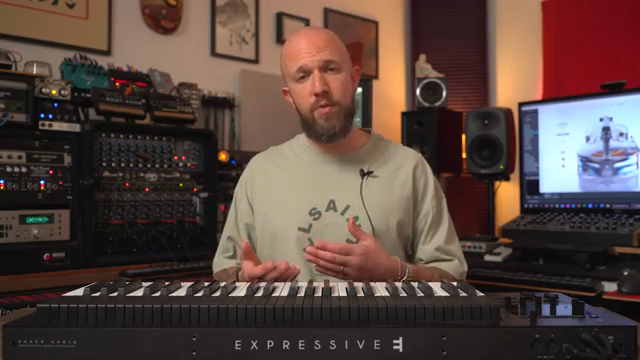
The video opens with composer Josh Madoff introducing the pairing of Expressive E’s Osmose keyboard and the Soliste plugin, setting the stage for a demonstration that’s all about expressive digital string performance. Soliste is positioned not as another sample-based library, but as a new breed of string instrument—one that leverages physical modeling to break free from the static nature of traditional sample sets.
Expressive E’s vision, as reflected in both their hardware and software, is to make electronic instruments as playable and nuanced as their acoustic counterparts. This ethos is front and center here: the focus is on how Soliste, designed specifically for MPE workflows, responds to the most subtle gestures, translating them into a dynamic, emotionally resonant string soundscape.
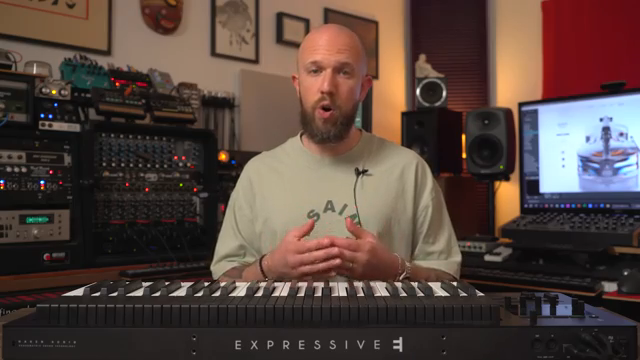
"No matter how nice they sound, your articulations and tonal qualities will always be limited to exactly how they were recorded."
© Screenshot/Quote: Expressivee (YouTube)
Physical Modeling: The Engine Behind the Magic
"This gives you the ability to control the sound of your library with much greater nuance and detail."
© Screenshot/Quote: Expressivee (YouTube)
Physical modeling is presented as the technological backbone of Soliste, offering a fundamentally different approach from sample libraries. Instead of being limited to the articulations and timbres captured in a recording session, users can shape every aspect of the sound in real time. The plugin models the physical properties of string instruments—shape, material, resonance—allowing for a nearly infinite range of articulations and tonal colors.
This architecture means no more massive sample libraries eating up disk space, and the flexibility to morph between sounds that would otherwise require dozens of key switches or patches. However, the video doesn’t shy away from the complexity: programming a physical modeling engine can be daunting, with parameter sets that dwarf those of typical sample libraries.
Expressive E’s solution is to sidestep deep menu-diving by leveraging the Osmose’s MPE capabilities. Instead of laborious programming, the player’s gestures become the primary interface, letting musicians intuitively sculpt sound and articulation in real time—an architectural shift that’s as much about workflow as it is about sound quality.
Control Architecture: Pitch, Bow, and Beyond
Soliste’s control scheme is split into two main domains: pitch and bow. Pitch control can be entirely manual—every bend and vibrato coming directly from the player’s gestures—or assisted, with the plugin providing vibrato support that can be dialed in for amplitude, fade-in, and speed. This hybrid approach allows for both raw expressiveness and performance safety nets, especially useful for those less comfortable with continuous pitch control.
The bow section is equally flexible, offering modes like sustain, back and forth, and programmable tremolo. Each mode responds to pressure, aftertouch, and finger movement, translating MPE data into nuanced bowing articulations. The inclusion of an attack envelope, resonant body selection, EQ, timbre filtering, and reverb rounds out the plugin’s sound-shaping arsenal. Articulation menus are deep, with both long and short options and further sub-variants, making Soliste a true playground for expressive control.
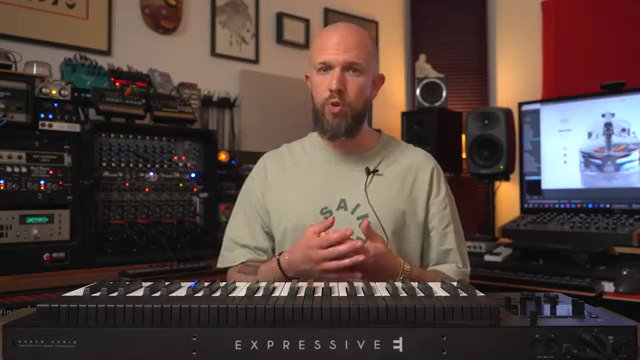
"There's two main sections of control in Soliste. You have the pitch and the bow."
© Screenshot/Quote: Expressivee (YouTube)
From DAW Template to Cinematic Quartet: Workflow in Action
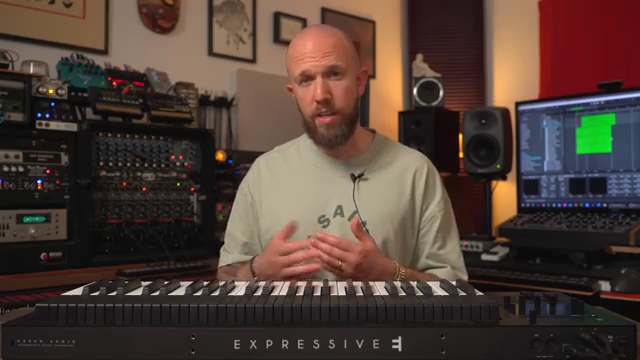
"MPE makes this a relatively painless process, especially compared to editing traditional sample libraries."
© Screenshot/Quote: Expressivee (YouTube)
The video moves from feature overview to practical workflow as Madoff builds a cinematic string arrangement inside a DAW. He sets up a quartet template—violin, viola, cello, and bass—all routed through a shared effects bus for cohesion. Each part is recorded individually, with the performer using Soliste’s articulations and the Osmose’s MPE sensitivity to capture nuanced dynamics and phrasing.
Editing is a key part of the process: MPE data for pitch, slide, and pressure is easily adjusted in the DAW, allowing for fine-tuning of expression curves and timing. Quantization is used judiciously to retain human feel, and articulation changes are made on the fly, demonstrating how Soliste’s architecture supports both real-time performance and detailed post-production. The workflow is streamlined, yet flexible—ideal for composers who need both speed and depth.
Expressive Playability: Osmose and Soliste in Concert
As the arrangement expands, the video showcases how Soliste’s responsiveness to the Osmose’s MPE data enables a level of playability that’s rare in digital string libraries. The composer layers multiple quartets, explores both long and short articulations, and demonstrates advanced techniques like Bartok pizzicato and col legno—all with real-time expressive control.
The pairing of Osmose and Soliste allows for subtle variations in dynamics, attack, and timbre, with each gesture immediately reflected in the sound. The plugin’s architecture supports complex arrangements without bogging down the workflow: articulations are switched seamlessly, and the sound remains cohesive even as the texture thickens.
Throughout, the focus remains on musicality and intuition. The system rewards nuanced playing, but also provides enough assistance (via vibrato and bowing aids) to keep the process fluid. The result is a digital string workflow that feels less like programming and more like performance—a testament to the architectural synergy between hardware and software.
This article is also available in German. Read it here: https://synthmagazin.at/expressive-es-soliste-osmose-ein-neues-paradigma-fuer-spielbare-streicher/
Watch on YouTube:
Latest articles
Watch on YouTube:
Visit the channel:
https://www.youtube.com/ExpressiveE
https://www.youtube.com/ExpressiveE
Links from ExpressiveE:
Sponsored links:
If you purchase via these links, we may earn a small commission – at no extra cost to you. The link opens an Amazon keyword search, and results may vary depending on availability.
Osmose
🔗 Check price on Amazon
🔗 Check price on Amazon
Soliste
🔗 Check price on Amazon
🔗 Check price on Amazon