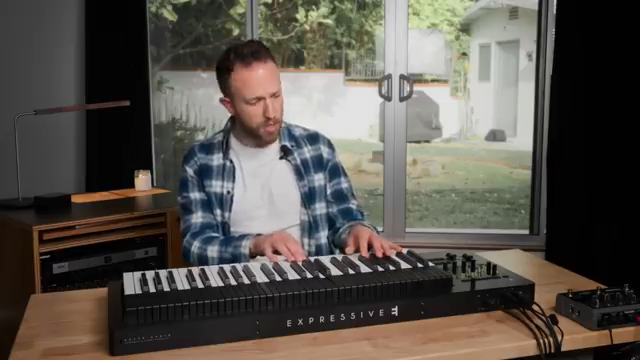
Expressive E’s Osmose isn’t just another MPE keyboard—it’s a deep, gestural synthesizer designed to bridge the gap between nuanced acoustic performance and digital sound design. In this inaugural Creative Tutorials episode, film composer Josh Madoff walks us through seven essential tips that showcase the Osmose’s unique sensitivity, per-key expressiveness, and innovative workflow features. Whether you’re a seasoned keyboardist or a synth-curious beginner, this video from Expressive E demonstrates how the Osmose’s architecture invites both subtlety and sonic adventure. We dig into the details, from pressure glides to macro controls, to see how this instrument redefines what it means to play expressively.
10. July 2024
LYRA
Expressive E’s Osmose: 7 Essential Tips for Gestural Synthesis Mastery
A New Paradigm: Osmose as an Expressive Playground
Expressive E positions the Osmose as a genuinely innovative MPE gestural synthesizer, aiming to make expressive play accessible to musicians of all backgrounds. The video opens with film composer Josh Madoff demonstrating the instrument’s remarkable sensitivity, which can be adjusted from standard to what he humorously calls “psychotic sensitivity.” Even the lightest feather-touch is detected, making the Osmose feel almost telepathic in its responsiveness.
This sensitivity isn’t just a party trick—it’s foundational to the Osmose’s design philosophy. Each key independently tracks vertical and horizontal gestures, allowing for nuanced, per-note control that goes far beyond traditional keyboard action. The result is an instrument that feels alive under your fingers, ready to translate the subtlest intention into sound, whether you’re a beginner or a seasoned performer.

"It feels like it's reading my mind."
© Screenshot/Quote: Expressivee (YouTube)
Dialing in Sensitivity, Aftertouch, and Pitch-Bend: Per-Key Nuance Unleashed
"Each of the 500 internal presets."
© Screenshot/Quote: Expressivee (YouTube)
One of the Osmose’s core strengths is its ability to modulate sound in real time through a combination of sensitivity settings, aftertouch, and pitch-bend—all independently per key. The video demonstrates how pressing a key halfway engages a cushion, and pushing further activates aftertouch, with each of the 500 internal presets responding differently. This means that every patch can offer a unique expressive palette, and aftertouch is not a global effect but a per-note phenomenon.
The gestural nature of the Osmose is highlighted through examples: a short attack produces one timbre, a gentle attack yields another, and aftertouch introduces yet another layer. These can be combined or played simultaneously, enabling complex, layered performances. Importantly, the video shows that these gestures are not mutually exclusive—players can blend them in real time, even with one hand, for dynamic soundscapes.
Pitch-bend is equally flexible. Madoff explains how the pitch-bend range can be set to fractions of a semitone, allowing for violin-like vibrato or more dramatic bends. The system is forgiving: set to a narrow range, even aggressive wiggles sound musical. This per-key pitch-bend, combined with pressure glide, opens up new expressive territory that’s simply not possible on conventional keyboards.
MPE Arpeggiator: Individual Note Tracking for Inventive Patterns
The Osmose’s MPE arpeggiator stands out as a truly unique feature, offering per-note tracking of dynamics and gestures. Unlike traditional arpeggiators that treat all notes uniformly, the Osmose tracks not just velocity but also left-right pitch shifts and vertical gestures for each note in the arpeggio. This enables performances where each note can have its own dynamic contour and pitch modulation, resulting in highly musical and intuitive patterns.
The video demonstrates how subtle variations in touch can create intricate polyrhythms and textures. Even notes played so softly they’re nearly inaudible can influence the rhythm, giving the player a level of control and expressiveness that feels more akin to classical piano technique than to typical synth arpeggiation. It’s a workflow that rewards both experimentation and finesse.

"The next feature I'd like to show you is completely unique in the world to this instrument."
© Screenshot/Quote: Expressivee (YouTube)
Pressure Glide: Seamless Transitions and Multi-Note Expressiveness
Pressure glide is introduced as a powerful tool for creating seamless transitions between notes, based on relative pressure rather than fixed pitch intervals. By setting a minimal interval—say, two semitones—any notes played within that range will glide smoothly between each other as the player varies pressure. Anything beyond that interval remains unaffected, allowing for both subtle and dramatic effects within the same performance.
The video showcases both understated and extreme uses of pressure glide. With a narrow interval, glides are gentle and musical, perfect for expressive phrasing. Expanding the interval to a major seventh or even the full keyboard enables massive, sweeping transitions, with the Osmose intelligently managing multiple simultaneous glides in any direction. The system’s flexibility is underscored by its ability to handle up to 96 steps, and the intelligent octave switcher ensures that preserved notes and pedal-held chords remain stable during even the most dramatic glides.
This feature is not just a technical novelty—it’s a genuine performance tool that encourages creative exploration. Whether used for subtle articulation or wild, multi-octave sweeps, pressure glide adds a dimension of expressiveness that’s rare in digital instruments.
Macros, Effects, and Pedals: Flexible Sound Shaping and Dynamic Performance

"Within each preset, there's seven macros that you can use to very drastically shape and change the sound."
© Screenshot/Quote: Expressivee (YouTube)
At the heart of the Osmose is the Eagan Matrix sound engine, which offers seven macro controls per preset for deep, immediate sound shaping. The video demonstrates how these macros, along with global effects like EQ, compression, and gain staging, can be mapped to external controllers via MIDI CC. This mapping process is straightforward, and every parameter in the internal engine is accessible, making the Osmose highly adaptable to different performance setups.
One standout aspect is the pre-gain control, which transforms into a wavefolder distortion when pushed beyond a threshold—instantly morphing a mellow flute into a gnarly, harmonically rich sound. This flexibility allows users to move from musical to experimental textures with just a few knob turns, reducing the need for post-processing and making the instrument equally at home in film scoring and sound design contexts.
Pedal integration is another area where the Osmose breaks new ground. Instead of the traditional all-or-nothing sustain, pedals offer 0–127 dynamic control, and the sostenuto function allows the keyboard to remain fully playable while holding and dynamically shaping chords. With two sostenuto pedals, users can bring in multiple chord sequences and control their dynamics independently, all while keeping both hands free for further expression.
The video closes by combining these techniques—macros, pedals, gestures, and the intelligent octave switcher—demonstrating how the Osmose supports complex, layered performances. For composers and performers alike, this architecture provides a scalable, expressive toolkit that encourages both precision and playfulness.
This article is also available in German. Read it here: https://synthmagazin.at/expressive-e-osmose-7-essentielle-tipps-fuer-gestische-synthese-auf-neuem-niveau/
Watch on YouTube:
Latest articles
Watch on YouTube:
Visit the channel:
https://www.youtube.com/ExpressiveE
https://www.youtube.com/ExpressiveE
Links from ExpressiveE:
Sponsored links:
If you purchase via these links, we may earn a small commission – at no extra cost to you. The link opens an Amazon keyword search, and results may vary depending on availability.
Osmose
🔗 Check price on Amazon
🔗 Check price on Amazon