Expert Sleepers, long known for bridging modular hardware and computer-based workflows, takes a spatial leap with the Quadraphonic Mixer mode for the disting EX. This firmware update transforms the multi-tool module into a six-input, four-output mixer designed for immersive spatial audio—think Buchla-era quad, not just cinema surround. The official video walks through its gain structure, coordinate systems, and modulation options, all rendered in binaural for headphone listeners. If you’ve ever wondered how to throw your sounds around a room with joystick sweeps, spinners, and CV, this is a deep-dive into the patchable possibilities of quadraphonic mixing in a single module.
28. May 2024
MILES
Expert Sleepers Disting EX: Quadraphonic Mixer Mode – Spatial Audio in Eurorack
A Patchable Portal to Quadraphonic
The video opens with Expert Sleepers presenting the disting EX’s new Quadraphonic Mixer mode, a conceptually straightforward but rarely seen feature in Eurorack. Here, the disting EX becomes a six-input, four-output mixer tailored for quadraphonic spatial audio—a format with roots in early Buchla systems, where four speakers are arranged in a square around the listener. Unlike modern surround setups that emphasise front-back separation, this classic quad approach treats all four corners as equals, inviting more immersive and democratic spatialisation.
With four outputs mapped to front left, front right, rear left, and rear right, the module is designed for genuine quad listening—though, as the video notes, YouTube’s limitations mean the demonstration is rendered binaurally for headphone use. This sets the stage for a hands-on exploration of spatial mixing, with the promise of real-time panning and movement across a virtual soundfield.
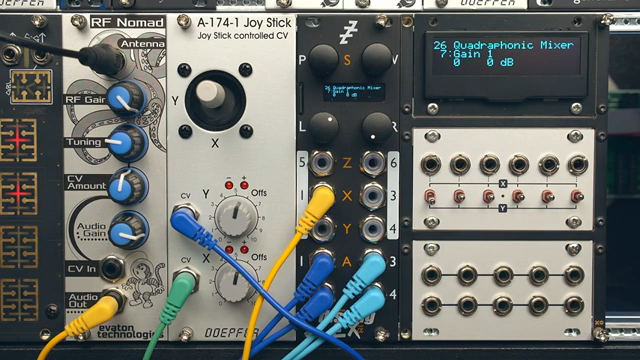
"To hear this properly you're going to need four speakers."
© Screenshot/Quote: Expertsleepersltd (YouTube)
Gain, Coordinates, and CV: The Heart of Spatial Control
"You've got gain, a choice of coordinates which is rectangular or polar that you'll come back to and then those two coordinates and then a choice of spinner and spin radius and spin phase."
© Screenshot/Quote: Expertsleepersltd (YouTube)
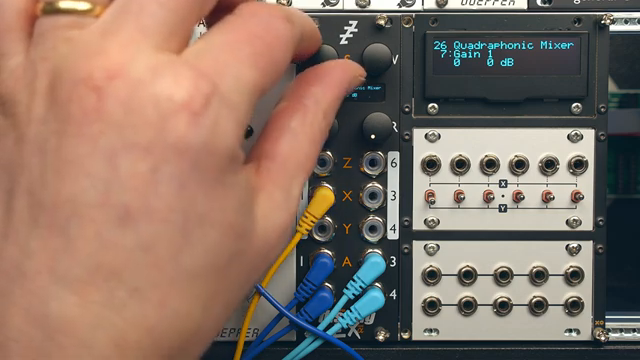
At the core of the Quadraphonic Mixer are controls for gain, coordinate systems, and CV mapping, all of which shape how sounds traverse the spatial field. Each of the six input channels offers independent gain, allowing precise balancing of sources before they’re sent into the quad environment. The video demonstrates this with a simple noise source, making it easy to hear panning and movement.
The coordinate system is a key feature, offering both rectangular (X/Y) and polar (angle/radius) modes. Rectangular coordinates let you move sounds left-right and front-back, ideal for joystick control or CV automation. Polar coordinates, on the other hand, allow you to spin a sound around a central point by adjusting angle and radius—mathematically elegant and musically expressive. The trade-off between using inputs for audio versus CV is highlighted, with suggestions to use MIDI or I2C for more complex control without sacrificing audio channels.
Spinners and Sound Choreography
The disting EX Quadraphonic Mixer introduces the concept of spinners—programmable movement paths for each channel. Each input can be assigned a spinner, with controls for spin radius, rate, and phase. This enables everything from simple circular motion to more complex, layered spatial choreography, where multiple sounds can chase each other around the room or move in offset patterns.
The video points out that channels can share spinners, allowing for phase-offset movement—imagine two sounds orbiting the listener in quadrature. With just a single sound source in the demo, the full effect isn’t realised, but the potential for intricate spatial layering is clear. The spinner’s rate can be dialled up for rapid movement or reversed for counter-rotation, offering a wide palette of dynamic motion for live or generative patches.
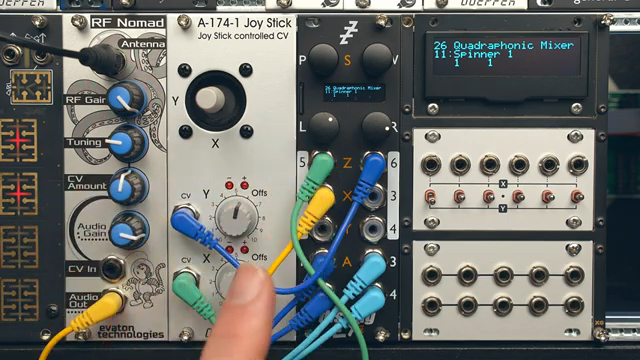
"If channels share spinners then you can offset them around that spin and you can have things that spin around kind of chasing each other around a circle."
© Screenshot/Quote: Expertsleepersltd (YouTube)
Utility Controls: Balancing, Taming, and Saturating
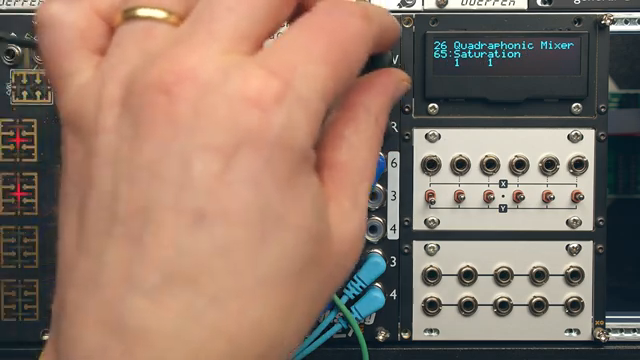
"If you want it to saturate rather than clip you can turn that on that stops if your levels get too high it's just going to kind of crush it which usually sounds better than actual digital distortion so that's on by default."
© Screenshot/Quote: Expertsleepersltd (YouTube)
Beyond spatial movement, the Quadraphonic Mixer provides a suite of utility controls to adapt to real-world setups. Overall gain lets you set the master level, while separate front and rear gain controls help balance mismatched speaker pairs—handy if your quad rig is cobbled together from two stereo PAs. Tone controls for both front and rear outputs allow you to compensate for differences in speaker voicing or to deliberately sculpt the soundfield.
A saturation option is included, echoing features from other disting EX algorithms. When enabled, it prevents harsh digital clipping by gently crushing the signal as levels rise, resulting in a more musically pleasing overdrive. This is on by default, ensuring the mixer remains forgiving even in the heat of a spatially adventurous performance.
From Patch Bay to Performance
The video wraps up by referencing a live performance where the Quadraphonic Mixer mode was put to the test in a true four-speaker setup. While YouTube’s binaural rendering can only hint at the full experience, the demonstration underscores the disting EX’s ability to deliver immersive, patchable spatial audio in a modular context. For those looking to add a new dimension to their Eurorack rig, this mode offers a compelling entry point into the world of quadraphonic performance.
This article is also available in German. Read it here: https://synthmagazin.at/expert-sleepers-disting-ex-quadraphonic-mixer-mode-raeumlicher-sound-im-eurorack/
Watch on YouTube:
Latest articles
Watch on YouTube:
Visit the channel:
https://www.youtube.com/ExpertSleepersLtd
https://www.youtube.com/ExpertSleepersLtd
Links from ExpertSleepersLtd:
Sponsored links:
If you purchase via these links, we may earn a small commission – at no extra cost to you. The link opens an Amazon keyword search, and results may vary depending on availability.
Expert Sleepers disting EX
🔗 Check price on Amazon
🔗 Check price on Amazon