DivKid’s back in the bunker with Joranalogue’s Walk 4, a quad Brownian accumulator that’s less ‘utility module’ and more ‘CV street weapon’. Forget your polite random sources—this thing’s a battery for voltage chaos, a sample & hold with a PhD and a bad attitude. Across modulation, noise, and full-on oscillator duties, Walk 4 proves it’s not just clever, it’s downright essential for anyone who likes their patches unpredictable and their beats crunchy. If you think random should mean ‘boring’, DivKid’s demo will slap you out of it.
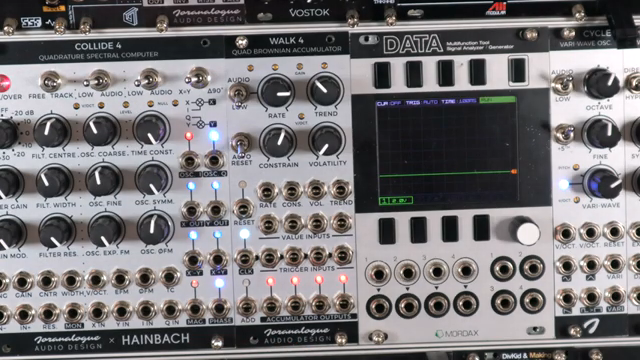
Meet the Brownian Bruiser
DivKid wastes no time dropping us into the deep end: Walk 4 from Joranalogue is a quad Brownian accumulator, and if that sounds like something from a 1960s computer lab, you’re not far off. But don’t panic—this isn’t some academic exercise. Joranalogue calls it a “battery for CV” and “a sample and hold with a master’s degree,” which translates to: it stores and accumulates voltages in ways that make regular random modules look like they’re still in nappies.
With four independent channels, internal noise, and a clock that swings from sub-audio to full audio rates, Walk 4 is designed to manipulate voltages in ways your average S&H can only dream of. DivKid’s style is all about showing, not telling—so expect plenty of patch examples and zero hand-holding. If you’re after a polite, menu-driven randomiser, look elsewhere. This is voltage mayhem, pure and simple.
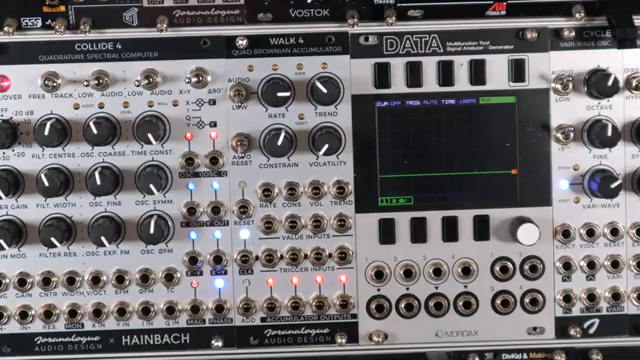
"Walk 4 is a battery for CV, and that it's like a sample and hold with a master's degree."
© Screenshot/Quote: Divkid (YouTube)
Random Walks and Staircase Raves
Walk 4’s controls aren’t just for show—they’re a playground for voltage mischief. Volatility dials in the chaos, trend pushes your signals up or down, constrain acts like a voltage compressor, and auto-reset keeps things from running off the rails (or lets them, if you want). You can patch in external signals, triggers, or just let the internal noise generators do their thing.
The result? Stepped random walks, staircase waveforms, and everything in between. You can make it behave like a drunken staircase, a predictable ramp, or a wild blend of both. DivKid’s demo makes it clear: this isn’t just about random for the sake of random—it’s about sculpting voltage in ways that make your patch sing, stutter, or collapse into beautiful chaos. If you want to see exactly how each control warps your CV, the video’s scope shots are a must.
Modulation Mayhem: Arps and Auto-Melodies
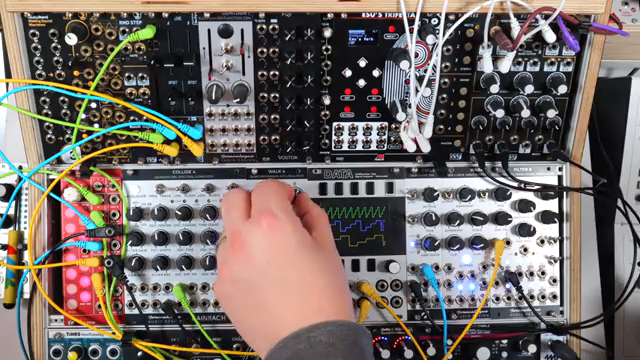
"The whole pattern just kind of blossoms across those three channels into taking more steps to rise up through that staircase before they all auto reset."
© Screenshot/Quote: Divkid (YouTube)
Here’s where Walk 4 earns its rave bunker stripes. DivKid shows it off as a central modulation hub, spitting out four channels of stepped signals to drive everything from filter sweeps to morph controls. Want polymetric, polyphonic arpeggios? Easy—just patch the outputs into quantisers and let Walk 4’s staircases climb, reset, and overlap. Suddenly, your patch is alive with evolving patterns that sound more like an algorithmic jam partner than a static sequencer.
But the real kicker is using Walk 4 to generate new melodies from existing v/oct sequences. By sampling and accumulating voltages at different rates, you get auto-accompanying lines that are always musically relevant but never predictable. It’s like having a modular mate who’s always got a new bassline up their sleeve. The possibilities are wild—and if you want to hear those polymetric arps and counter-melodies in action, you’ll need to watch DivKid’s hands-on patching.
Noise, Crunch, and Percussive Grit
Walk 4 isn’t just a CV wizard—it’s a noise monster. Crank up the rate and volatility, and you get everything from soft wind to digital chirps to full-on mechanical tape failure. DivKid patches Walk 4’s outputs straight into VCAs and filters, whipping up percussion that’s as crunchy as a broken toaster. The module’s internal noise sources and stepped outputs make it a goldmine for weird drum textures and lo-fi effects.
It’s not just about static noise, either. By modulating volatility and constrain, you can morph between subtle hiss and aggressive crackle, or even simulate vinyl dropouts and tape mangling. If you’re tired of sterile white noise, Walk 4’s approach is a breath of fresh, filthy air. The video’s patch breakdowns are essential viewing if you want to steal some of these tricks for your own rack.
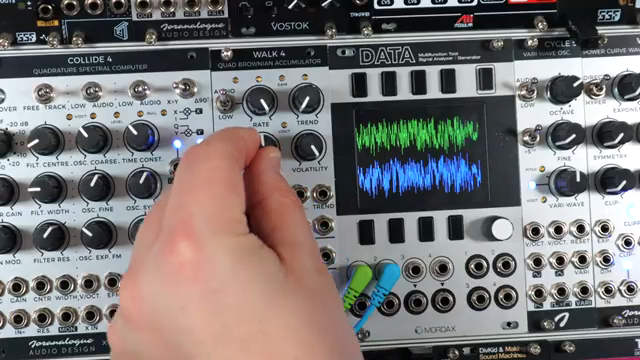
"Notice how much weight's added, it's thicker, there's more low frequencies."
© Screenshot/Quote: Divkid (YouTube)
Oscillator Insanity: Chords and Harmonics
Just when you think Walk 4’s done, DivKid flips it into oscillator mode. By abusing the constrain, trend, and auto-reset controls, you get staircase waveforms that can be sequenced, synced, and stacked into four-voice chords. Subharmonic locking, just intonation, and multiple sub-oscillators? All on tap, all in 10HP. It’s like a digital chord machine, except it’s all analog and all attitude.
The harmonic content is thick, dirty, and surprisingly musical. Whether you’re after classic hard sync tones, subharmonic intervals, or just want to stack up some gnarly chords, Walk 4 delivers. DivKid’s patching is fast and fearless—if you want to see how deep the rabbit hole goes, the video’s chord and subharmonic demos are unmissable. This isn’t just a random module; it’s a full-blown sonic street weapon.
This article is also available in German. Read it here: https://synthmagazin.at/divkid-testet-walk-4-brownsche-chaosmaschine-im-eurorack/
Watch on YouTube:
Latest articles
Watch on YouTube:
Visit the channel:
https://www.youtube.com/DivKid
https://www.youtube.com/DivKid
Links from DivKid:
Patreon: https://patreon.com/divkid
Website: https://divkidvideo.com
Instagram: https://instagram.com/divkidvideo
Twitter: https://twitter.com/divkid
Facebook: https://facebook.com/Sir.DivKid
Sponsored links:
If you purchase via these links, we may earn a small commission – at no extra cost to you. The link opens an Amazon keyword search, and results may vary depending on availability.
Joranalogue Walk 4
🔗 Check price on Amazon
🔗 Check price on Amazon