Make Noise, the Asheville-based champions of modular mischief, return with a deep dive into MultiMod’s more eccentric read shapes. This official walkthrough eschews the usual smooth LFO fare, instead focusing on staircase, ramp, and randomised orbits—each offering a different flavour of discontinuity. The video methodically demonstrates how these shapes can be harnessed for everything from stepped modulations to unpredictable gate streams, all while keeping the patching practical and the metaphors suitably crunchy. For those interested in sound design that’s more coleslaw than consommé, this is a must-watch.

10. April 2025
MILES
Chunky Orbits and Stepped Realities: Make Noise Explores MultiMod’s Shaping Power
MultiMod: More Than Just Smooth Moves
Make Noise kicks things off by positioning the MultiMod as a module that goes far beyond the classic LFO shapes. While most modular users are familiar with the likes of ramp, triangle, and sine, MultiMod’s read shapes—forward, backward, ping pong, wow, and flutter—invite a more adventurous approach to waveform manipulation. The video establishes that these read shapes are not just theoretical abstractions but practical tools for carving out new sonic territory.
The focus quickly shifts to the less conventional shapes available on the MultiMod. Rather than sticking with the familiar, Make Noise encourages users to explore how these shapes affect playback and modulation. The promise is clear: MultiMod isn’t just about cycling through waveforms, but about actively sculpting and discontinuously reimagining the input signal for more complex and interesting audio results.
Staircase and Ramp: Stepping Through Sound
The heart of the demonstration lies in the staircase and ramp shapes, which fundamentally alter how the MultiMod processes incoming signals. The staircase shape, in particular, is highlighted as an alternative to the classic ramp—offering a stepped, rather than smooth, progression through the input material. Instead of a continuous sweep, the playback jumps at discrete intervals, creating a choppy, quantised rendition of whatever is fed into the module.
By patching in a cycling function from Maths, the video makes these differences audible. Fast spread settings yield a tightly stepped output, while slowing things down exaggerates the length of each step, eventually abstracting the input beyond recognition. The spread control further allows for channel differentiation, resulting in a patch that’s as visually jagged as it is sonically. It’s a clear illustration of how MultiMod’s shapes can transform even the simplest modulation source into something far more intricate.

"So instead we have the staircase shape when this input is in use."
© Screenshot/Quote: Maken0Isemusic (YouTube)
Chopping, Mixing, and Morphing: Shaping Techniques in Action
"I really like to think of it as I'm eating the Multimod."
© Screenshot/Quote: Maken0Isemusic (YouTube)
With the basics established, the video leans into the metaphor of sound as food—likening the MultiMod’s discontinuous shapes to making coleslaw or a smoothie. This isn’t just whimsy; it’s a practical way to think about how the module chops and mixes input signals. By adjusting time, spread, and shape, users can determine just how rough or smooth their sonic concoction becomes.
The demonstration shows that by tweaking these parameters, one can move between highly stepped, almost granular modulations and smoother, more blended results. The interplay between the module’s controls invites experimentation, rewarding those who aren’t afraid to push the MultiMod into less predictable territory. It’s a reminder that modular synthesis is as much about process as it is about outcome.
Randomness and Probability: Controlled Chaos
Randomisation is introduced as a key ingredient in MultiMod’s palette. Switching to step random, the module assigns each channel a random position in its orbit at its own clock rate, breaking away from direct representation of the input shape. However, the input’s contour still influences the probability distribution—logarithmic functions bias the output high, exponential ones bias it low, and linear shapes yield even spread.
The video goes further, demonstrating how attenuating and offsetting the input can constrain the range of random outputs, enabling targeted randomness. Feeding in a gate stream transforms the MultiMod into a probabilistic gate generator, with pulse width and duty cycle controlling the likelihood of output events. Modulating these parameters in real time, or clocking the module for regularity, opens up a world of evolving, unpredictable rhythms—ideal for those who crave a bit of chaos in their patches.
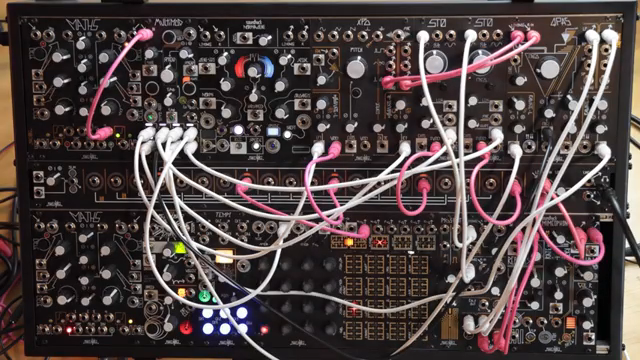
"But the shape does have an effect because it determines the likelihood of any given value."
© Screenshot/Quote: Maken0Isemusic (YouTube)
Ramp Let's: A Call for Creative Patching

"Let us know in the comments because I think it'd be fun to make that video as exhaustive as possible."
© Screenshot/Quote: Maken0Isemusic (YouTube)
The final section spotlights the Ramp Let’s shape, which randomly selects a starting point before moving forward through the input, producing a flock of miniature, offset curves. The presenter hints at the depth of creative potential here—suggesting that Ramp Let’s deserves its own dedicated exploration. Viewers are invited to share their own patch ideas in the comments, reinforcing the open-ended, community-driven ethos that Make Noise is known for.
This article is also available in German. Read it here: https://synthmagazin.at/chunky-orbits-und-gestufte-realitaeten-make-noise-erforscht-die-multimod-shaping-power/
Watch on YouTube:
Latest articles
Watch on YouTube:
Visit the channel:
https://www.youtube.com/MAKEN0ISEMUSIC
https://www.youtube.com/MAKEN0ISEMUSIC
Links from MAKEN0ISEMUSIC:
website: https://www.makenoisemusic.com
instagram: https://www.instagram.com/makenoisemusic
twitter: https://twitter.com/makenoisemusic
facebook: https://www.facebook.com/makenoiseco
Sponsored links:
If you purchase via these links, we may earn a small commission – at no extra cost to you. The link opens an Amazon keyword search, and results may vary depending on availability.
Make Noise Maths
🔗 Check price on Amazon
🔗 Check price on Amazon
Make Noise MultiMod
🔗 Check price on Amazon
🔗 Check price on Amazon