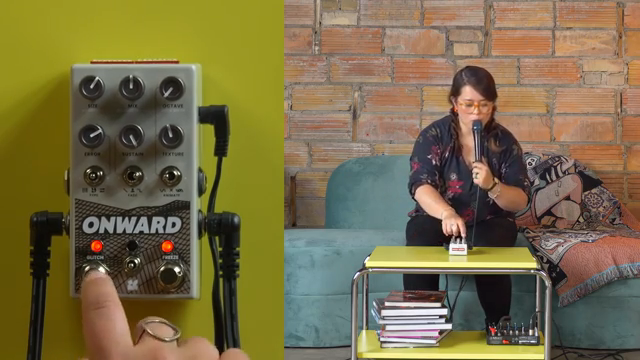
Chase Bliss, known for their playful yet sophisticated approach to effects, throws their Onward pedal into the vocal ring with a session that’s as much about discovery as it is about sound design. In this video, vocalist Courtney Swain is let loose on Onward for the first time, exploring its transformative impact on live vocals and ambient textures. The pedal’s blend of analog richness and digital trickery is front and centre, with modes and features that invite both chaos and control. If you’re curious about how a pedalboard staple can become a compositional tool for the adventurous, this is a deep dive worth your patch cables.
3. July 2024
MILES
Chase Bliss Onward: Pushing Vocals Into Uncharted Territory
A New Voice for Live Performance
The Onward pedal is introduced as a transformative force for vocalists, inviting users to step beyond traditional effects and into the realm of real-time sound manipulation. Courtney Swain’s initial reactions capture the sense of unpredictability and excitement that Onward brings, with its ability to saturate, stutter, and glitch the vocal signal in the stereo field. This isn’t just about adding reverb or delay; it’s about fundamentally reshaping the voice into something new and mysterious.
From the outset, the pedal’s character is clear: it’s designed for those who want their vocals to become part of a larger, evolving soundscape. The video demonstrates how Onward can serve as a live performance tool, enabling spontaneous textures and layers that would be difficult to achieve with more conventional gear. The sense of adventure is palpable, and the pedal’s potential for creative exploration is front and centre.

"That's such an exciting sound and I could see that being so cool in the context of just using this as a live effect."
© Screenshot/Quote: Chaseblissaudio (YouTube)
Manual Mode: Capturing and Layering the Moment
"It's like I'm taking my one voice and adding two more."
© Screenshot/Quote: Chaseblissaudio (YouTube)
Diving into manual mode, Onward offers a hands-on approach to capturing and manipulating vocal lines. Courtney explores how a single phrase can be split and reimagined, with two distinct capture methods allowing for both immediate and held sounds. This flexibility means a vocalist can add parallel voices on the fly, turning a solo performance into a layered, polyphonic experience.
The video highlights how the pedal’s architecture lets users assign roles to different voices—one acting as a bass foundation, another providing glitchy, rhythmic textures. This modular approach to layering feels intuitive and rewarding, especially for those used to building patches in a Eurorack environment. Onward’s manual mode becomes a playground for spontaneous composition, where each button press can yield a new sonic direction.
Sidechain and Ducking: Dynamic Texture Sculpting
Onward’s integrated sidechain and ducking features add a new dimension to vocal processing, allowing the pedal to respond dynamically to incoming signals. The ducking function, in particular, is described as a floating element that’s pushed down by the vocal input, creating space and movement within the texture. This isn’t just a studio trick—it’s a live tool for carving out rhythmic interplay between layers.
The demonstration shows how these features can introduce both subtle and dramatic shifts in the soundscape, with rhythmic pulses and evolving textures emerging from the interplay of voice and effect. For modular enthusiasts, this kind of dynamic modulation is reminiscent of patching envelopes and VCAs, but here it’s all wrapped up in a pedalboard-friendly box. The result is a vocal track that breathes and reacts, full of unexpected twists.

"I'm trying to internalize it. Like there's a duck floating duck and you push it down."
© Screenshot/Quote: Chaseblissaudio (YouTube)
Pedalboard Integration and Songcraft

"Like 20 more musicians and just being like here. Here's my idea just like, you know what I'm thinking do it for me."
© Screenshot/Quote: Chaseblissaudio (YouTube)
The video moves on to show how Onward fits into a broader pedalboard setup, highlighting its role at the end of the signal chain. Courtney describes the sensation of bringing in a host of new voices and timings, as if summoning an ensemble of invisible musicians to interpret her ideas. This integration transforms the pedal from a simple effect into a compositional partner, capable of filling out arrangements with ambient washes and rhythmic fragments.
The practical demonstration within a song context reveals how Onward can replace or augment other pedals, providing both space-filling ambience and intricate, evolving patterns. For performers looking to streamline their board without sacrificing complexity, Onward offers a compelling solution—one that rewards experimentation and rewards those willing to let go of strict control.
Adventure and Discovery: The Onward Ethos
Throughout the video, there’s a strong sense of playful discovery as Courtney experiments with prompts and settings, sometimes battling a rogue fly but always returning to the pedal’s creative possibilities. The process is less about precision and more about embracing the unknown, letting the pedal’s quirks and random elements shape the performance. This ethos aligns perfectly with Chase Bliss’s reputation for encouraging exploration and happy accidents.
By the end, it’s clear that Onward isn’t just another effect; it’s an invitation to adventure. The pedal’s forward-moving, story-driven nature encourages users to see their voice as a starting point for sonic journeys. Whether used for ambient soundscapes or rhythmic experimentation, Onward promises to keep performers on their toes, always searching for the next unexpected twist.
This article is also available in German. Read it here: https://synthmagazin.at/chase-bliss-onward-vocals-auf-abwegen-ein-abenteuer-mit-courtney-swain/
Watch on YouTube:
Latest articles
Watch on YouTube:
Visit the channel:
https://www.youtube.com/ChaseBlissAudio
https://www.youtube.com/ChaseBlissAudio
Links from ChaseBlissAudio:
website: https://www.chasebliss.com
instagram: https://www.instagram.com/chasebliss
facebook: https://www.facebook.com/chasebliss
twitter: https://twitter.com/chaseblissaudio
discord: https://discord.gg/chasebliss
Sponsored links:
If you purchase via these links, we may earn a small commission – at no extra cost to you. The link opens an Amazon keyword search, and results may vary depending on availability.
Chase Bliss Onward
🔗 Check price on Amazon
🔗 Check price on Amazon