Chase Bliss, the Minnesota pedal alchemists, have unleashed Onward—a pedal that blurs the lines between looping, glitching, and real-time performance. In their latest Q&A video, the team digs into what sets Onward apart from its siblings, focusing on how it follows your playing like a second instrument and integrates naturally into your setup. From full-frequency freeze to rhythmic pattern generation and nuanced sustain control, this session is a treasure trove for anyone wondering how Onward might fit into their pedalboard or modular workflow. If you’re curious about stereo tricks, signal chain placement, or just want to hear some dry Midwestern humour, this one’s worth a listen.
14. June 2024
MILES
chase bliss Onward: A Glitchy Companion for Creative Signal Chains
Onward: Not Just Another Glitch Box
Chase Bliss positions Onward as a pedal that doesn’t just loop or glitch in isolation—it actively follows your playing, almost like a second instrument shadowing your every move. Unlike traditional loopers where you set up a pad or a static loop, Onward captures and returns audio in real time, latching onto whatever you play and feeding it back immediately. This approach means the pedal isn’t just a passive recorder, but an interactive partner that responds to each new chord or note as you play.
The video demonstrates how this immediacy translates into a more organic performance experience. Instead of laboriously building up layers, you can play a chord or a single note and have Onward instantly grab and repeat it, allowing for spontaneous soundscapes or glitchy textures that evolve with your input. It’s a design that encourages live interaction and rewards those who like their effects to feel like part of the instrument, not just an afterthought at the end of the chain.

"Anything you're putting into it, you're immediately getting back out."
© Screenshot/Quote: Chaseblissaudio (YouTube)
Freeze Without Compromise
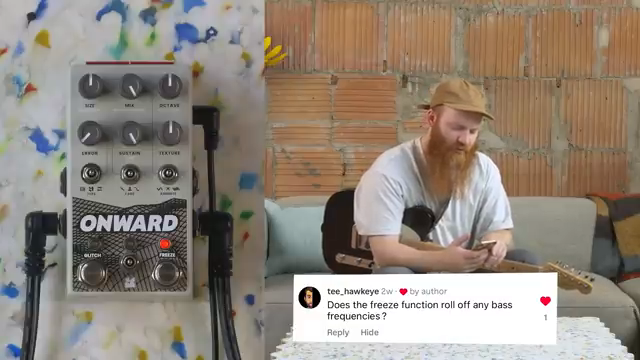
"We have designed Onward to be full frequency."
© Screenshot/Quote: Chaseblissaudio (YouTube)
One of the standout features of Onward is its Freeze function, which Chase Bliss assures maintains a full frequency response. Unlike some freeze or hold effects that roll off the low end, Onward keeps bass frequencies intact, ensuring that your frozen textures retain their weight and presence. This makes it especially appealing for synth and bass players who rely on the full spectrum of their sound.
Rhythmic Potential: More Than Just Ambient Wash
Onward isn’t limited to ambient pads or static drones—it can get staccato and rhythmic, acting almost like a pattern generator. The pedal allows you to feel and manipulate the pulse, making it possible to create percussive or syncopated effects that move with your playing. This rhythmic flexibility means Onward can slot into more groove-oriented patches, not just ambient soundscapes.

"You can kind of feel where that pulse is sitting and just almost use it as like a pattern generator."
© Screenshot/Quote: Chaseblissaudio (YouTube)
Sustain: Infinite or Responsive—You Choose

"It will repeat forever until you tell it to stop repeating."
© Screenshot/Quote: Chaseblissaudio (YouTube)
Sustain on Onward is more than just a hold function—it’s a dynamic tool that can be set for infinite repeats or tailored to respond to your playing. With the sustain knob cranked, any note or chord you play will ring out indefinitely until you actively stop it. This is ideal for those moments when you want a loop to persist as a foundation for further exploration.
Dialing back the sustain knob introduces a gating effect, where the looped audio will only persist for a set period before fading out. This allows for more nuanced, performance-driven control, letting you decide whether a sound should linger or quickly make way for the next idea. The pedal listens to your dynamics, so even a muted string or a soft touch can retrigger or silence the loop, making sustain a truly interactive parameter.
Signal Chain Strategy: Early Bird Gets the Glitch
Chase Bliss recommends placing Onward as early in your signal chain as possible. This ensures the pedal receives the cleanest signal, which is crucial for accurate envelope tracking and dynamic response. If you run delays or other effects before it, Onward will respond to those repeats or modulations, potentially muddying its ability to follow your playing. For those building complex boards or modular rigs, this advice is key to integrating Onward’s responsive character into your setup.
This article is also available in German. Read it here: https://synthmagazin.at/chase-bliss-onward-ein-glitchiger-begleiter-fuer-kreative-signalwege/
Watch on YouTube:
Latest articles
Watch on YouTube:
Visit the channel:
https://www.youtube.com/ChaseBlissAudio
https://www.youtube.com/ChaseBlissAudio
Links from ChaseBlissAudio:
website: https://www.chasebliss.com
instagram: https://www.instagram.com/chasebliss
facebook: https://www.facebook.com/chasebliss
twitter: https://twitter.com/chaseblissaudio
discord: https://discord.gg/chasebliss
Sponsored links:
If you purchase via these links, we may earn a small commission – at no extra cost to you. The link opens an Amazon keyword search, and results may vary depending on availability.
Onward
🔗 Check price on Amazon
🔗 Check price on Amazon