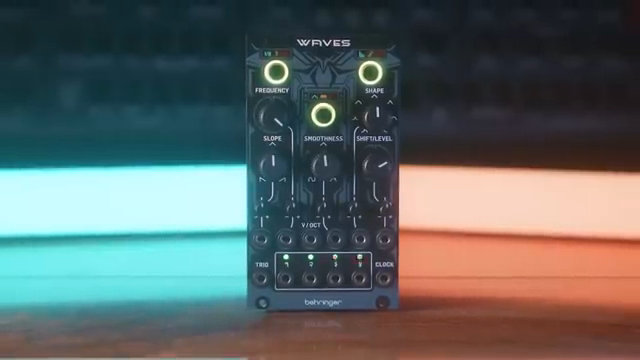
Behringer dives into the deep end of digital modulation with WAVES, a function generator and tidal modulator inspired by Mutable Instruments Tides. In their latest video, the brand showcases how this module moves beyond the basics, offering a toolkit for everything from sculpted LFOs to complex VCO duties. With its multi-mode architecture and hands-on controls, WAVES promises to inject new life into any Eurorack setup—whether you’re after polyrhythmic modulations or harmonically rich soundscapes. We take a closer look at what Behringer demonstrates, and how WAVES might ripple through your modular workflow.
27. November 2024
MILES
Behringer WAVES: A Tidal Modulator for the Modern Eurorack
A New Wave in Function Generation
Behringer opens their presentation by challenging the notion that function generators are the wallflowers of the modular world. While filters and VCOs often steal the limelight, WAVES is positioned as something far more adventurous—a digital tidal modulator that reimagines the humble looping AD envelope. The emphasis is on creative modulation, with the promise of expanding sound design horizons beyond the usual suspects.
The module is introduced as an ocean of possibilities, hinting at its flexibility and depth. Rather than sticking to conventional envelope duties, WAVES is pitched as a tool for those who want to push boundaries, whether that’s through intricate LFOs, evolving envelopes, or even as a multi-wave VCO. The tone is set for a module that aims to be both versatile and inspiring in the rack.
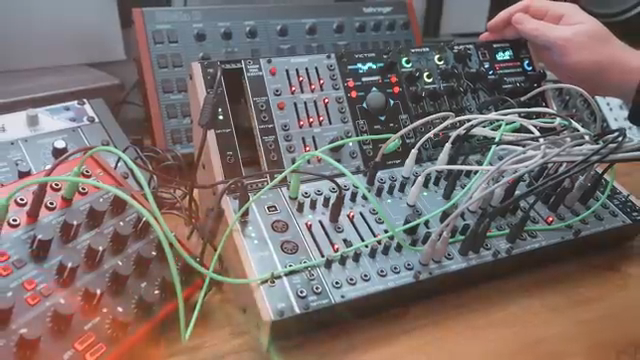
"From intricately sculpted LFOs and envelopes to a multi-wave shape VCO, this is an ocean of creative possibilities."
© Screenshot/Quote: Behringer (YouTube)
Inspired by Tides: Digital Heritage and Multi-Functionality
"Based on the fantastic mutable instrument's tides, it can create precisely crafted LFOs and envelopes, and can also be used as a dedicated multi-wave shape VCO."
© Screenshot/Quote: Behringer (YouTube)
WAVES draws direct inspiration from Mutable Instruments Tides, a module well-known for its blend of digital precision and organic modulation. Behringer makes it clear that WAVES is not just a clone, but a reimagining that leverages the core concepts of Tides—namely, the ability to generate precisely crafted LFOs and envelopes, as well as to serve as a multi-wave shape VCO.
The video highlights the module’s three generator modes—AD, AR, and looping—alongside four output modes that cover shapes, amplitudes, timings, and frequencies. This multi-functionality is at the heart of WAVES’ appeal, offering users a palette of modulation and audio-rate options that can be tailored to a wide range of patching scenarios.
Modes Galore: Generator and Output Flexibility
At the core of WAVES are three generator modes: AD (attack/decay), AR (attack/release), and looping. These modes allow users to switch between envelope and cyclic behaviours, making the module equally at home as a modulation source or as a VCO. The four output modes, each with a dedicated shift control, further expand the module’s versatility, enabling everything from classic envelope shapes to complex, phase-shifted outputs.
Behringer underscores how these modes interact, with frequency ranges spanning from slow LFOs up to audio rates. The module’s architecture encourages experimentation, whether you’re after snappy envelopes, evolving LFOs, or harmonically rich oscillations. The combination of generator and output modes is designed to foster complex signal shaping and modulation layering within a single module.
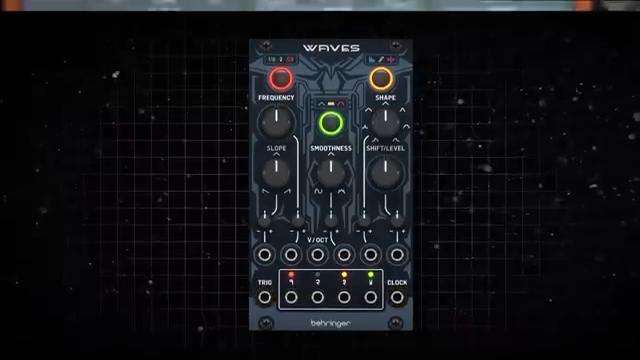
"Now, Waves is definitely more than your average function generator, and it also does work in a unique way, of course, being based on tides."
© Screenshot/Quote: Behringer (YouTube)
Hands-On Control: CV, Wave Shapes, and Workflow
WAVES is outfitted with CV inputs and an attenuverter for each main control, providing a high degree of modulation flexibility. There’s also a volt-per-octave input for pitch tracking, four dedicated outputs with LED feedback, and both trigger and clock inputs to sync or retrigger envelopes and LFOs. This suite of connectivity options positions WAVES as a central modulation hub in any Eurorack system.
The asymmetric triangle function generator forms the backbone of the module, followed by a wavetable waveshaper that morphs between linear, exponential, logarithmic, sinusoidal, and arc-sinusoidal shapes. A secondary processor offers either a two-pole low-pass filter for smoothing or a wave folder for adding harmonic complexity. The frequency and slope controls behave differently depending on the selected mode, allowing for nuanced shaping of both envelopes and oscillations.
Behringer demonstrates how these controls interact in practice—showing, for instance, how the slope control morphs between sawtooth and reverse sawtooth in cyclic mode, or how the smoothness parameter transitions from filtering to wave folding. The overall design encourages hands-on tweaking and invites users to explore creative workflows, whether modulating filters, generating audio-rate textures, or clocking the module for rhythmic effects.
Output Modes: From Polyrhythms to Harmonic Riches
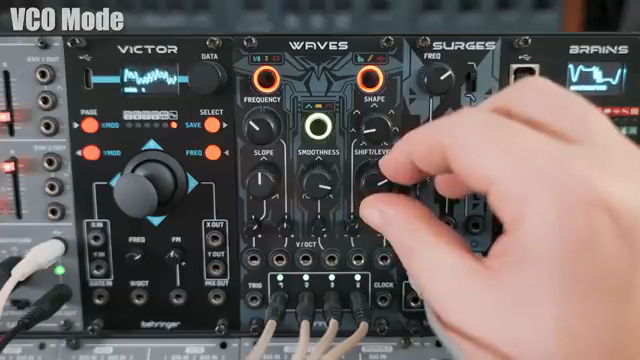
"Then at low frequencies, it gets even more interesting as it generates polyrhythmic LFOs."
© Screenshot/Quote: Behringer (YouTube)
The four output modes are where WAVES truly reveals its depth. In the default mode, each output delivers a different wave shape—ranging from the fully processed main signal to raw triangle, square, and pulse waves. This allows for classic VCO duties as well as layered modulation. The shift control acts as an attenuverter or crossfader, depending on the mode, giving further control over the output mix.
Other output modes introduce mixer-like crossfading, phase-shifted outputs, and frequency ratio manipulation. These features enable everything from polyrhythmic LFOs to stacked harmonic chords, depending on the frequency range and patching context. The video demonstrates how mixing outputs or using the module at different rates can yield everything from chunky basses to evolving soundscapes, underscoring WAVES’ potential as both a modulation powerhouse and a sound source.
This article is also available in German. Read it here: https://synthmagazin.at/behringer-waves-ein-tidal-modulator-fuer-das-moderne-eurorack/
Watch on YouTube:
Latest articles
Watch on YouTube:
Visit the channel:
https://www.youtube.com/behringer
https://www.youtube.com/behringer
Links from behringer:
website: https://www.behringer.com
facebook: https://www.facebook.com/Behringer
twitter: https://twitter.com/BEHRINGER
instagram: https://instagram.com/Behringer
Sponsored links:
If you purchase via these links, we may earn a small commission – at no extra cost to you. The link opens an Amazon keyword search, and results may vary depending on availability.
Behringer WAVES
🔗 Check price on Amazon
🔗 Check price on Amazon