The Bastl Instruments 1983 isn’t just another MIDI-to-CV box—it’s a polyphonic mastermind designed to bring order (and a bit of creative chaos) to your modular rig. In this deep-dive video, Bastl’s Václav walks through every feature, from automatic oscillator tuning to inventive quantizer tricks, showing how the 1983 can unite digital and analog voices in perfect harmony. As typical for Bastl’s community-driven approach, the presentation is hands-on, patch-oriented, and full of clever workflow ideas. If you’ve ever struggled to keep your oscillators in tune or wanted to push your modular into new polyphonic or microtonal territory, this is one to watch.
19. January 2025
MILES
Bastl Instruments 1983: Polyphonic MIDI-to-CV Wizardry for the Modular Age
Meet the 1983: Polyphony Meets Precision
Bastl Instruments’ 1983 is introduced as a clever polyphonic MIDI-to-CV interface, purpose-built for modular synth enthusiasts who crave both precision and flexibility. The module’s headline feature is its ability to automatically tune oscillators, a perennial headache in the world of analog modular. With four output channels—each offering CV and gate—the 1983 translates MIDI data into the modular domain, making it possible to control multiple voices with ease.
The device is pitched as a solution for those who want to use their modular in a highly tonal context, but it’s clear from the outset that Bastl has packed in a host of creative features. The video promises a thorough walkthrough of every function, setting the stage for a module that’s as much about musical exploration as it is about technical accuracy.
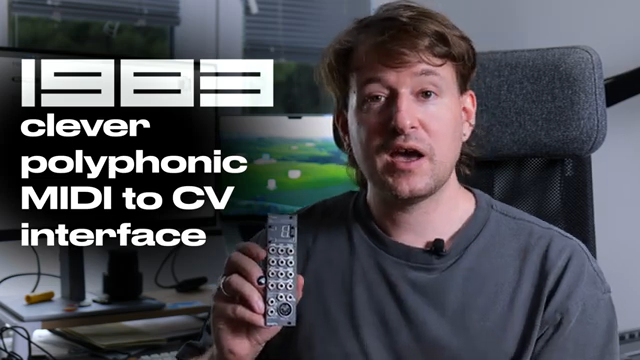
"It has automatic tuning of the oscillators, but it can also work as a quantizer and has a bunch of other creative tricks."
© Screenshot/Quote: Bastlinstruments (YouTube)
Automatic Tuning, Custom Layouts, and Creative CV
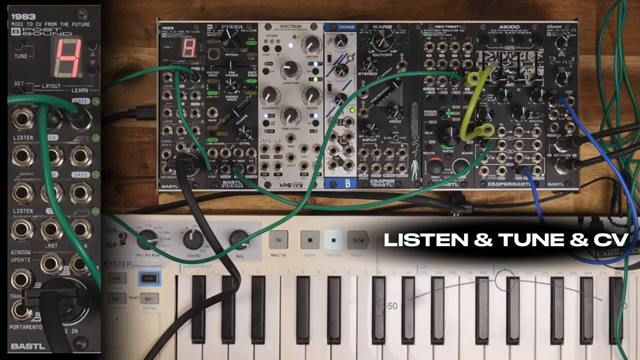
"Because the 1983 has the listen input, I can simply connect the pulse output, which outputs the same frequency as the main oscillator."
© Screenshot/Quote: Bastlinstruments (YouTube)
One of the 1983’s standout features is its automatic tuning system. By patching each oscillator’s output into the module’s listen inputs, users can have the 1983 calibrate the pitch across all octaves, compensating for imperfections in analog designs. The process is straightforward: connect, press tune, and let the module handle the rest—even correcting for non-exponential tracking and drift. This is demonstrated with a mix of digital and analog oscillators, including a self-oscillating filter pressed into service as a fourth voice.
Beyond tuning, the 1983 offers four CV inputs—portamento, transpose, update, and window—each opening up creative possibilities. These can be used for arpeggiation, time quantization, and more, allowing MIDI information to be transformed in modular-specific ways. The module’s flexibility extends to its layouts, which define how MIDI data is routed to the outputs, ranging from monophonic to full polyphonic modes.
With dedicated controls for tuning, layout selection, and channel assignment, the 1983 is designed to be both powerful and approachable. The video highlights how quickly users can switch between configurations, making it a practical tool for both studio and live modular setups.
Learn Mode: Assigning MIDI Channels with Finesse
The learn mode is a key workflow enhancer, letting users assign MIDI channels to specific oscillators or voices with minimal fuss. Entering learn mode, each output channel can be set to respond to a particular MIDI channel, or left in omni mode to listen to all channels. This is especially useful in complex arrangements where different voices need to be independently addressed.
The video demonstrates both the intuitive keyboard-based assignment—simply play a note on the desired MIDI channel—and manual selection via the module’s buttons. This flexibility means the 1983 can adapt to a wide range of MIDI controllers and performance scenarios, from layered synth textures to split-keyboard setups.
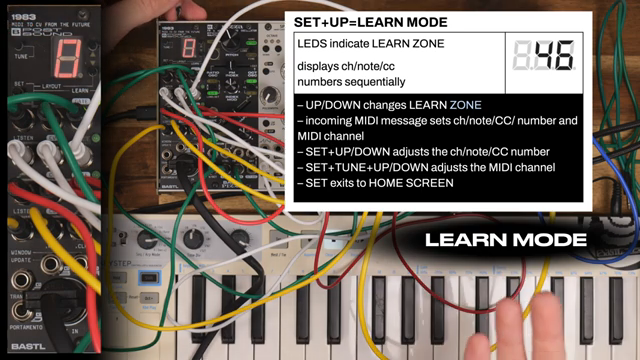
"When I hit the up and down buttons, I'm gonna change learn zone, which means I can learn a midi channel for each of those four oscillators."
© Screenshot/Quote: Bastlinstruments (YouTube)
Layouts Galore: Polyphony, Drums, and MIDI Control
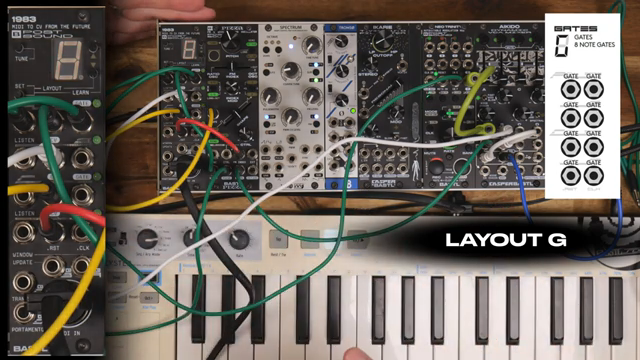
"This mode is basically designed for the use with let's say a drum machine."
© Screenshot/Quote: Bastlinstruments (YouTube)
The 1983’s layout system is a modularist’s playground, offering a variety of configurations to suit different musical tasks. Polyphonic layouts (P and P.) allow for four-voice or three-voice polyphony, with the option to dedicate a channel to MIDI clock output for tight DAW or sequencer integration. There are also layouts for complex monophonic voices, dual monophonic channels with velocity, and the classic four-channel monophonic setup—each with its own MIDI channel assignment options.
Drum and gate layouts (G and T) transform the module into a trigger/gate hub, ideal for controlling drum modules or percussive voices. Here, each gate or trigger output can be mapped to specific MIDI notes, and velocity outputs add expressive nuance to drum programming. The learn mode adapts to these layouts, making note and channel assignments a breeze.
A dedicated MIDI CC layout (C) turns the 1983 into a powerful MIDI controller interface, converting control change messages into CV or gate outputs. This opens up modulation possibilities from external controllers, allowing parameters like filter cutoff or FM index to be manipulated directly from a MIDI keyboard or sequencer.
Quantizer and Microtonality: Pitch Beyond the Ordinary
Perhaps the most intriguing feature is the integrated quantizer, which allows incoming CV to be snapped to user-defined scales or chords. The quantizer mode is highly interactive: users can define scales on the fly via MIDI input, or edit them note-by-note using the module’s controls. Each channel can operate as a quantizer or revert to standard MIDI-to-CV, enabling hybrid setups within a single patch.
The quantizer’s learn mode enables detailed scale editing, including the assignment of different MIDI channels to each quantizer channel. This makes it possible to run independent melodic lines or harmonies, each with its own tuning and scale mask. The gate outputs provide triggers whenever the quantized note changes, perfect for driving envelopes or rhythmic events.
Rounding out the feature set is a robust microtonal editing system. Users can create and store custom tunings, detune individual notes in fine increments, and access presets for just intonation or alternative reference pitches. This empowers adventurous patchers to break free from equal temperament, exploring everything from subtle detuning to radical new tonal systems—all within the modular context.
This article is also available in German. Read it here: https://synthmagazin.at/bastl-instruments-1983-polyphones-midi-cv-genie-fuer-das-modularzeitalter/
Watch on YouTube:
Latest articles
Watch on YouTube:
Visit the channel:
https://www.youtube.com/bastlinstruments
https://www.youtube.com/bastlinstruments
Links from bastlinstruments:
linkinbio: https://linkin.bio/bastlinstruments
instagram: https://instagram.com/bastlinstruments
facebook: https://facebook.com/bastlinstruments
twitter: https://twitter.com/bastlinstrument
soundcloud: https://soundcloud.com/bastl-instruments
Sponsored links:
If you purchase via these links, we may earn a small commission – at no extra cost to you. The link opens an Amazon keyword search, and results may vary depending on availability.
Bastl Instruments 1983
🔗 Check price on Amazon
🔗 Check price on Amazon