Arturia’s Augmented YANGTZE is not your average sample library or synth plugin—it’s a software instrument that fuses the evocative timbres of traditional Chinese instruments with the malleability of modern synthesis. In this official Arturia tutorial, Lena unpacks the instrument’s morphing architecture, showing how users can blend, modulate, and sculpt sound layers for evolving sonic landscapes. The focus is on workflow: from the advanced panel’s dual-layer setup to hands-on morph knob assignments and practical sound design using the haunting ‘Windy Day’ preset. If you’re curious about hybrid sound engines and dynamic modulation, this deep dive is for you.
3. May 2024
LYRA
Arturia’s Augmented YANGTZE: Morphing Acoustic Heritage with Digital Innovation
A New Hybrid: Augmented YANGTZE’s Sound Philosophy
Augmented YANGTZE stands out by merging the expressive qualities of traditional Chinese instruments with the flexibility of digital synthesis. Arturia’s approach is to create a platform where acoustic authenticity and synthetic manipulation coexist, allowing users to traverse a broad spectrum of timbres. The instrument isn’t just about sampling; it’s about reimagining familiar sounds through a digital lens.
This philosophy is evident in how the instrument is introduced: morphing is positioned as the core design principle, enabling users to move seamlessly between two distinct layers. The result is a tool that encourages experimentation and rewards those who seek evolving, contemporary textures rooted in acoustic heritage.
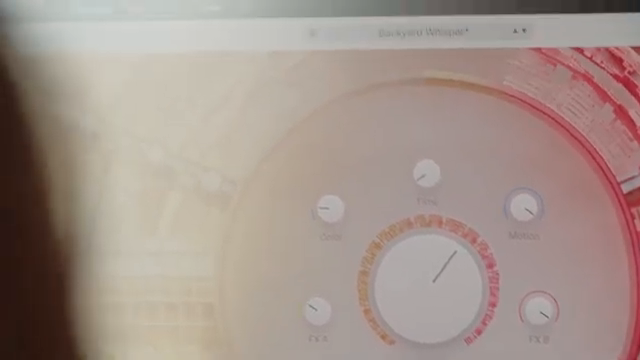
"This concept came to life as a way to take traditional acoustic instruments and push them into new sound forms to create captivating contemporary tones and timbres."
© Screenshot/Quote: Arturiaofficial (YouTube)
Morphing: The Heart of the Augmented Workflow
Morphing in Augmented YANGTZE is more than a simple crossfade—it’s a dynamic process that lets users blend two sound layers, each with their own engines and settings. The morph knob acts as a macro control, opening up a continuum of timbres between the extremes of acoustic and synthetic.
The video highlights how this feature provides not just smooth transitions, but also the ability to create complex, evolving soundscapes. By moving the morph knob, users can access a wide variety of tones, making the instrument suitable for everything from subtle underscoring to bold, experimental performances.
Inside the Advanced Panel: Layering and Synthesis Engines
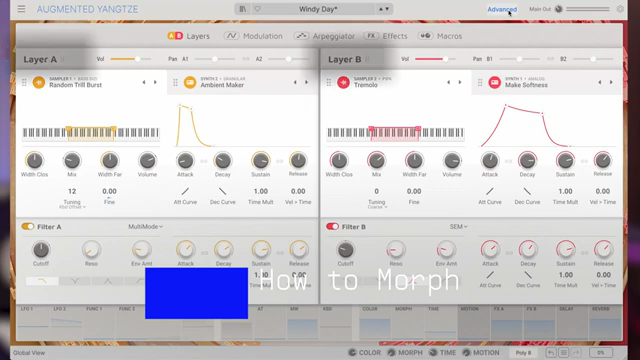
"Here in the Layers section we can see Layer A and Layer B. These are the two sound generators which both consist of two sound engines."
© Screenshot/Quote: Arturiaofficial (YouTube)
Diving into the advanced panel, Lena demonstrates how each layer—A and B—can be configured with two independent sound engines. These engines aren’t limited to samples; users can select from granular, wavetable, harmonic, and other synthesis types, giving each layer its own sonic identity. The flexibility here is key: you can pair a sampled guzheng with a granular pad, or any other combination that suits your creative needs.
Layer A, for example, is built with a sampled sound from the Bass Dece group and a granular engine providing an ambient texture. Each engine’s parameters, such as attack and filter settings, can be tweaked individually, allowing for intricate sound design. This modular approach encourages users to think architecturally about their patches, stacking and blending engines for maximum depth.
Morph Knob Modulation: Volume, Effects, and Beyond
The morph knob isn’t just a crossfader—it’s a modulation hub. Lena shows how users can assign the morph position to control the volume of each engine within both layers, specifying exactly when and how each sound comes in or fades out. This allows for precise sculpting of transitions, from subtle blends to dramatic shifts.
Beyond volume, the morph knob can modulate synth engine parameters and effects. For example, adding noise or adjusting frequency modulation on the fly, or tying the morph position to effects like dry/wet mix. This hands-on approach to modulation means every movement of the morph knob can introduce new harmonics, textures, and spatial effects, making the instrument highly expressive in performance or studio contexts.
"This logic applies to all layers and parts."
© Screenshot/Quote: Arturiaofficial (YouTube)
Case Study: ‘Windy Day’ and Real-World Sound Design
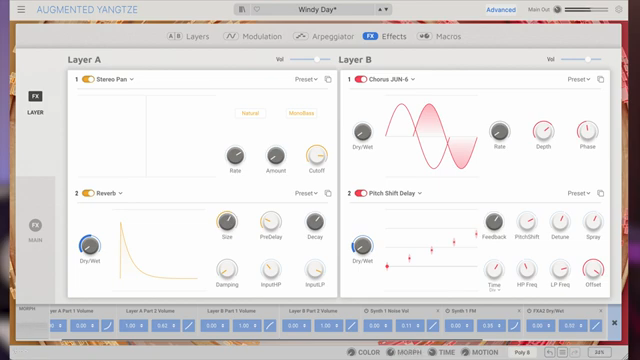
"Going back and forth between layers opens up a whole new sonic dimension where each position of the Morph knob offers different tones and colors of your sound."
© Screenshot/Quote: Arturiaofficial (YouTube)
The preset ‘Windy Day’ serves as a practical showcase for all these features. Lena reconstructs the patch from scratch, demonstrating how the interplay of layers, engines, and morph assignments results in a sound that evolves from organic and acoustic to modern and experimental. The workflow is transparent: each step in the patch-building process is shown, from engine selection to modulation routing.
The end result is a soundscape that feels alive, with the morph knob acting as a performance tool that unlocks new timbres at every position. This example underscores the instrument’s strength as a creative platform for composers and sound designers looking to push beyond static presets.
This article is also available in German. Read it here: https://synthmagazin.at/arturia-augmented-yangtze-morphing-zwischen-tradition-und-digitaler-innovation/
Watch on YouTube:
Latest articles
Watch on YouTube:
Visit the channel:
https://www.youtube.com/ArturiaOfficial
https://www.youtube.com/ArturiaOfficial
Links from ArturiaOfficial:
website: https://www.arturia.com
instagram: https://instagram.com/arturia_official
twitter: https://twitter.com/ArturiaOfficial
soundcloud: https://soundcloud.com/arturia-official/albums
Sponsored links:
If you purchase via these links, we may earn a small commission – at no extra cost to you. The link opens an Amazon keyword search, and results may vary depending on availability.
Arturia Augmented YANGTZE
🔗 Check price on Amazon
🔗 Check price on Amazon