When Arturia teams up with Virtual Riot, you know you’re in for a deep dive into the architecture of modern sound design. In this official Arturia video, German-born bass music heavyweight Virtual Riot unpacks his creative workflow using Pigments 7, showcasing how its multi-engine synthesis and modulation tools drive both the technical and musical sides of his productions. From granular textures to random modulation tricks, the session is a masterclass in turning digital flexibility into club-ready, festival-shaking results. If you’re curious about how a top-tier producer bends a flagship synth to his will—and how that translates to real-world performance and collaboration—this walkthrough is a must-watch.

27. January 2026
LYRA
Arturia Pigments 7: Virtual Riot’s Bass-Forward Sound Design Playground
From Piano Roots to Bass-Heavy Innovation
Virtual Riot opens the session by tracing his journey from classical piano beginnings in Germany to his current status as a US-based DJ and producer. He emphasizes how his exposure to both musicality and technical sound design has shaped his distinctive approach to dubstep and bass music. The influence of live performance is front and center: seeing what energizes a crowd directly informs his production decisions, blending the worlds of songwriting and engineering.
Arturia’s legacy in analog emulation and hybrid instrument design gets a nod, with Virtual Riot recalling his early experiences with their Minimoog plugin. He highlights the appeal of combining analog warmth and sampled acoustic elements—like those found in Arturia’s augmented instruments—with the cutting-edge synthesis tools that Pigments 7 brings to the table. This sets the stage for a workflow that values both expressive playability and technical depth.
"How can we abuse this? How can we make the most crazy, surprising, alien sounds?"
© Screenshot/Quote: Arturiaofficial (YouTube)
Pigments 7: Synthesis Engines for Every Texture
Pigments 7’s architecture is showcased as a true multi-engine powerhouse, with Virtual Riot praising its ability to cover everything from aggressive wavetable basses to lush, granular atmospheres. He demonstrates how the synth’s diverse engines—wavetable, granular, and modal—can be layered and sculpted to create complex, evolving patches entirely within the plugin. The inclusion of high-quality effects and a broad filter palette further expands the sonic possibilities.
A particularly telling moment is the focus on the modal oscillator for physical modeling, where Virtual Riot explores exciter-resonator interactions and the subtleties of the warp and quantize controls. The workflow here is about more than just stacking sounds; it’s about leveraging the engine’s flexibility to craft patches that feel both organic and futuristic. Pigments 7 is positioned as a self-contained environment for both experimental sound design and bread-and-butter synthesis tasks.
Random Modulation: Breathing Life into Digital Patches
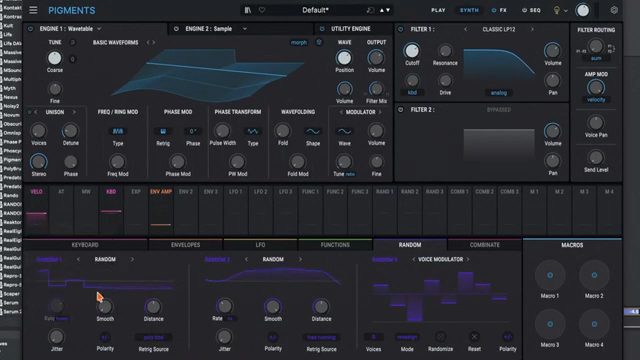
"So now our notes are randomly flying left or right, like each new note is gonna have a random pan assigned to it."
© Screenshot/Quote: Arturiaofficial (YouTube)
A recurring theme in Virtual Riot’s workflow is the use of random modulation to inject subtle, analog-style imperfections into digital sounds. He walks through setting up random modulators in Pigments 7—switching them to freeze mode so each new note receives a unique value—and routing them to parameters like oscillator fine-tune, filter pan, and even glide time. This approach simulates the slight detuning and drift you’d expect from classic analog polysynths, but with far greater control and flexibility.
The practical impact is immediate: even simple saw waves gain a sense of movement and depth, while more complex patches become unpredictable in musically useful ways. Virtual Riot extends this technique to the modal oscillator, randomizing overtone levels for a more realistic, acoustic feel. This philosophy of controlled chaos is central to his dubstep sound design, where liveliness and variation are prized over sterile repetition.
He also reflects on the creative process itself, drawing parallels between building domino chains as a child and constructing musical sequences in a DAW. The message is clear: playfulness and experimentation are not just side effects, but essential drivers of innovation in electronic music production.
Collaboration in Motion: Music Meets Visuals
The final segment shifts from solo sound design to the collaborative dynamic between Virtual Riot and VJ Nuray. Their workflow is a real-time exchange, with music and visuals evolving together to maximize the impact of live shows. Decisions about sonic details—like when to add a laser-friendly moment or tweak an intro for visual emphasis—are made in tandem, underscoring the importance of cross-disciplinary feedback.
This partnership highlights how modern performance setups increasingly blur the lines between audio and visual artistry. Pigments 7’s flexibility supports this by enabling rapid iteration and adaptation, whether for a festival mainstage or a more intimate club context. The result is an immersive experience where every element, from bass drop to light show, is tuned for maximum audience engagement.
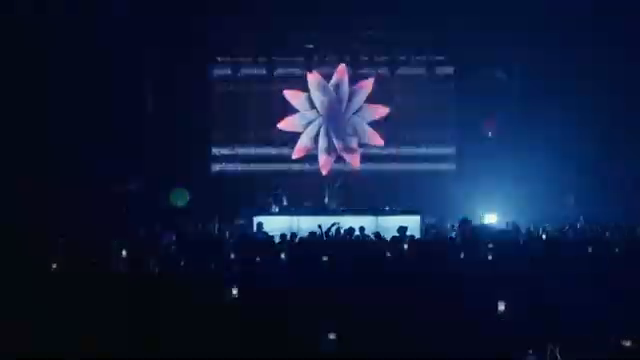
"We do a lot of back and forth where like, I might make something or an idea and then he might change something about the song."
© Screenshot/Quote: Arturiaofficial (YouTube)
This article is also available in German. Read it here: https://synthmagazin.at/arturia-pigments-7-virtual-riots-bass-getriebener-sounddesign-spielplatz/
Watch on YouTube:
Latest articles
Watch on YouTube:
Visit the channel:
https://www.youtube.com/ArturiaOfficial
https://www.youtube.com/ArturiaOfficial
Links from ArturiaOfficial:
website: https://www.arturia.com
instagram: https://instagram.com/arturia_official
twitter: https://twitter.com/ArturiaOfficial
soundcloud: https://soundcloud.com/arturia-official/albums
Sponsored links:
If you purchase via these links, we may earn a small commission – at no extra cost to you. The link opens an Amazon keyword search, and results may vary depending on availability.
Arturia Pigments 7
🔗 Check price on Amazon
🔗 Check price on Amazon