Arturia’s Pigments 6 takes center stage in this deep-dive video, where the modal engine is put through its paces within a modern drum & bass context. Guided by Brendan Void, the breakdown unpacks how core presets from the Modal Explorations sound bank shape everything from punchy basslines to crystalline arpeggios and layered atmospheres. The focus here is on workflow: macro controls, filter automation, and the creative repurposing of presets are all highlighted, giving us a clear look at Pigments’ digital flexibility. If you’re curious about how a single synth engine can drive an entire arrangement, this is a breakdown worth your attention.
22. August 2025
LYRA
Arturia Pigments 6: Modal Engine Dissected – A Track Breakdown in Digital Detail
Modal Engine in Action: The Track’s Digital Backbone
The video opens with Brendan Void introducing a drum & bass track constructed entirely from the Modal Explorations sound bank within Pigments 6. Right from the outset, the focus is on how the modal engine underpins the arrangement, providing not just a palette of sounds but a foundation for the track’s energy and movement. The initial excerpt reveals a dense layering of breakbeats, deep bass, and sparkling arpeggios, all shaped by Pigments’ digital architecture.
Brendan sets the stage for a section-by-section breakdown, promising to explore how each sonic element is crafted and manipulated. This approach highlights the modal engine’s versatility, as it’s not just about static presets but about how those sounds are animated and transformed within a composition. The workflow here is methodical: bass first, then melodies, then transitional elements—mirroring the way many producers might approach building a track from the ground up.
"There's a lot happening in terms of sound design and layering, and it's all used in creative ways."
© Screenshot/Quote: Arturiaofficial (YouTube)
Presets with Personality: Bass, Arps, and Atmospheres
Diving into the bass section, the video spotlights the Surrender Bass preset, which is introduced with a muted tone thanks to filter cutoff automation. As the track evolves, macro controls—specifically the tone macro—are used to add drive and presence, while the super unison FX thickens the sound. Notably, the same preset is reprogrammed for a staccato, rhythmic line, demonstrating how a single patch can serve multiple roles just by tweaking macros and note programming.
The bass journey continues with two additional presets: Strange Timpani and Machinima. Strange Timpani employs dual modal engines and a snappy filter envelope for a punchy, percussive attack, while Machinima brings in a mid-range layer, heavily EQ’d and filtered for clarity. Macro controls here are again central, evolving the sound’s brilliance and introducing effects like chorus and compression. This section underscores how Pigments’ presets are more than static sounds—they’re starting points for dynamic, evolving layers in a track.
Macro Moves and Filter Tricks: Flexibility in the Engine
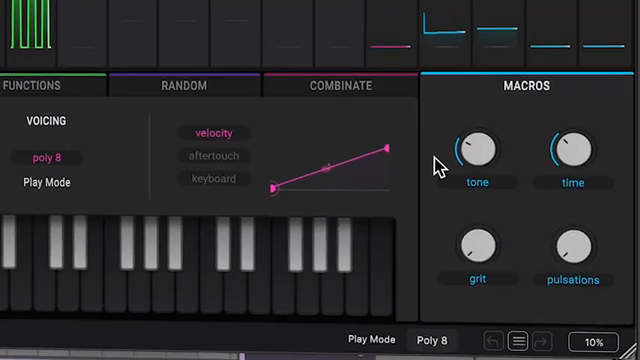
"What's cool here is how Macro 1, controlling tone and filter movement combined with different note programming lets the composer use a single preset for two completely different roles of the track."
© Screenshot/Quote: Arturiaofficial (YouTube)
A key theme throughout the breakdown is the use of filter automation and macro controls to morph sounds in real time. The Surrender Bass preset, for example, leverages Macro 1 to control both tone and filter movement, allowing the same patch to function as a subdued intro bass and a brighter, rhythmic motif. This flexibility is emblematic of Pigments’ digital design philosophy, where a single preset can be a chameleon within an arrangement.
Layering is also a highlight: the Strange Timpani and Machinima presets are stacked with identical note programming, yet their distinct timbres and macro-driven evolutions create a richer, more complex bass section. The video makes it clear that Pigments’ engine isn’t just about sound quality—it’s about how those sounds can be shaped, automated, and repurposed to serve multiple compositional needs without ever leaving the preset browser.
Melodic Layers: Building Motion and Atmosphere
The melodic exploration begins with a trio of sounds: Divided Motion (an arpeggiated patch with dual modal engines and analog-style warmth), Grain Spine (stereo-panned, with a reverse switch for sample playback and mod wheel-controlled stereo narrowing), and Take A Break (a resonant, evolving pad with macro-driven motion and randomized pitch modulation). Each is chosen for its ability to add momentum and depth, with macro and mod wheel assignments providing hands-on performance control.
Atmospheric and filler elements are also dissected. Perpetual brings in a haunting, metallic pad that evolves unpredictably, while Beam On Beams and Glidelock offer bright, percussive arpeggios and key sounds that punctuate transitions and breakdowns. The Aniseed preset stands out for its clever macro setup, allowing the user to shift emphasis between two engines and morph the tone in real time, especially when paired with riser presets for tension-building.
What emerges is a workflow where melodic and atmospheric layers are not just stacked, but interact dynamically through modulation and macro assignments. The result is a cohesive, evolving soundscape that demonstrates both the depth of Pigments’ modal engine and the thoughtfulness of its preset design. The video closes by crediting Victor Morello’s composition and reiterating the creative potential unlocked by modal synthesis in a digital context.
"Hopefully you've got a great sense of how versatile and inspiring the model exploration presets can be and how powerful model synthesis really is when used creatively."
© Screenshot/Quote: Arturiaofficial (YouTube)
This article is also available in German. Read it here: https://synthmagazin.at/arturia-pigments-6-modal-engine-seziert-ein-track-breakdown-im-digitalen-detail/
Watch on YouTube:
Latest articles
Watch on YouTube:
Visit the channel:
https://www.youtube.com/ArturiaOfficial
https://www.youtube.com/ArturiaOfficial
Links from ArturiaOfficial:
website: https://www.arturia.com
instagram: https://instagram.com/arturia_official
twitter: https://twitter.com/ArturiaOfficial
soundcloud: https://soundcloud.com/arturia-official/albums
Sponsored links:
If you purchase via these links, we may earn a small commission – at no extra cost to you. The link opens an Amazon keyword search, and results may vary depending on availability.
Arturia Pigments 6
🔗 Check price on Amazon
🔗 Check price on Amazon