Arturia returns to its own legacy with MiniBrute V, a software emulation of their iconic MiniBrute hardware synth. In this official walkthrough, Lena guides us through the digital reincarnation, spotlighting its expanded polyphony, flexible oscillator section, and a filter that channels the Steiner Parker spirit. The video doesn’t just stick to nostalgia: it dives into modulation, velocity, aftertouch, and a robust effects rack, all wrapped in a workflow-focused interface. For those curious about how Arturia translates analog grit into a modern, DAW-friendly instrument, this tutorial is a revealing deep-dive.
From Hardware Legend to Digital Playground
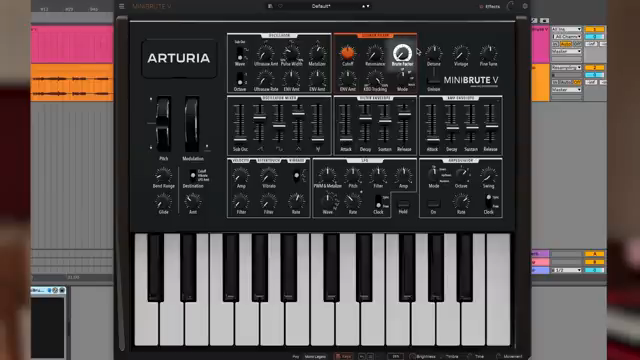
Arturia’s MiniBrute V emerges as a software homage to their original MiniBrute hardware, a synth that helped define the early 2010s analog resurgence. The video opens with Lena situating the MiniBrute V within Arturia’s own lineage, emphasizing its roots as a monophonic analog instrument now reborn in digital form. This isn’t just a cosmetic port: Arturia claims to have meticulously modeled the original’s raw energy while introducing new digital conveniences.
The MiniBrute V brings polyphony to the table—up to eight voices—while retaining a mono mode for purists. The addition of a built-in effects rack and patch browser signals a clear intent: to make the MiniBrute V not just a tribute, but a flexible tool for modern sound design and production. The interface aims to keep things direct, with a layout that echoes the hardware’s immediacy but leverages the benefits of software integration.
"MiniBrute V is a formidable synthesizer. We took great care to emulate it as closely as possible and improve it where it made sense."
© Screenshot/Quote: Arturiaofficial (YouTube)
Oscillators, Noise, and the Steiner Parker Filter: The Sonic Core
"It's the MiniBrute's signature sound, a special feedback circuit that takes the synth's output and feeds it back into its input to overdrive and distort our signal."
© Screenshot/Quote: Arturiaofficial (YouTube)
Diving into sound generation, MiniBrute V offers a single oscillator architecture, but with a twist: users can freely mix saw, square, triangle, and sub-oscillator waveforms. Each waveform comes with its own dedicated shaper—ultra saw for lush detuned textures, pulse width modulation for the square, and a metallizer for aggressive triangle tones. These can be modulated via envelopes or the LFO, allowing for animated and evolving timbres.
A sub-oscillator extends the low end, switchable between sine and square and tunable one or two octaves down, while a noise generator adds percussive bite or subtle texture. The mixer section isn’t just about blending; pushing levels into saturation territory introduces analog-style drive, a nod to the original’s character. The workflow here encourages experimentation, with immediate feedback as you shape and layer your sounds.
Central to the MiniBrute sound is the Steiner Parker-inspired filter, offering four modes: low pass, band pass, high pass, and notch. The filter’s resonance can be pushed into self-oscillation, and keyboard tracking allows for chromatic playability of the filter itself. The Brute Factor, a signature feedback circuit, injects gnarly distortion, amplifying the interplay between oscillators and filter. Envelope routing is flexible, with one envelope shared between filter and oscillator shapers, and another dedicated to amplitude, supporting both classic and experimental subtractive workflows.
Modulation and Expressive Control: LFOs, Velocity, and More
Modulation on the MiniBrute V is designed for both depth and immediacy. The LFO section offers multiple waveforms, tempo sync, and bipolar routing to key parameters, making it easy to inject movement into your patches. The arpeggiator provides hands-free melodic patterns, ideal for quick inspiration or live tweaking.
Expressive control is a clear focus: velocity sensitivity lets you shape amplitude and filter response dynamically, while aftertouch opens up further modulation possibilities for those with compatible controllers. Vibrato can be assigned to aftertouch or the mod wheel, and pitch glide (portamento) is adjustable for smooth transitions. These features combine to make MiniBrute V not just a static emulation, but a responsive instrument for nuanced performance.
"Velocity can modulate your parameters based on how hard or soft you hit the notes while playing."
© Screenshot/Quote: Arturiaofficial (YouTube)
Effects Rack: Sculpting and Expanding the Sound
"Here we have up to four boss effects that we can use simultaneously. It has an astonishing 17 available dynamic, spatial and modulation effects."
© Screenshot/Quote: Arturiaofficial (YouTube)
Arturia has equipped MiniBrute V with a built-in effects rack, pushing it beyond its hardware ancestor. Up to four effects can be loaded simultaneously, chosen from a palette of 17 dynamic, spatial, and modulation processors. Each effect comes with hands-on controls and a dry/wet fader, letting users dial in anything from subtle enhancement to radical transformation.
The workflow here is streamlined: effects are integrated directly into the main interface, with no need for external routing or plugin chains. This makes MiniBrute V a self-contained sound design environment, equally at home in a DAW or standalone context. The video demonstrates the dramatic difference between dry and processed signals, highlighting the creative range on offer.
Arturia’s inclusion of a dispersion setting—hidden above the pitch and mod wheels—adds another layer of realism, simulating analog imperfections and component drift. This subtlety can make patches feel more alive and less sterile, especially in polyphonic or layered contexts.
Creative Workflows and User Experience
The presentation wraps up by encouraging users to explore MiniBrute V’s creative potential. The interface is designed for immediacy, with most parameters accessible on a single screen and minimal menu-diving. This supports both fast sketching and deep sound design, making it suitable for everything from quick ideas to complex, evolving textures.
Arturia positions MiniBrute V as a tool for both newcomers and seasoned synth enthusiasts, emphasizing its balance of classic analog character and modern digital flexibility. The workflow is inviting, with clear visual feedback and intuitive modulation routing, setting the stage for dynamic performances and intricate soundscapes alike.
This article is also available in German. Read it here: https://synthmagazin.at/arturia-minibrute-v-analoge-wurzeln-digitale-fluegel/
Watch on YouTube:
Latest articles
Watch on YouTube:
Visit the channel:
https://www.youtube.com/ArturiaOfficial
https://www.youtube.com/ArturiaOfficial
Links from ArturiaOfficial:
website: https://www.arturia.com
instagram: https://instagram.com/arturia_official
twitter: https://twitter.com/ArturiaOfficial
soundcloud: https://soundcloud.com/arturia-official/albums
Sponsored links:
If you purchase via these links, we may earn a small commission – at no extra cost to you. The link opens an Amazon keyword search, and results may vary depending on availability.
Arturia MiniBrute V
🔗 Check price on Amazon
🔗 Check price on Amazon