Arturia’s KeyStep mk2 steps up as a compact yet ambitious controller and sequencer, aiming to be the nerve center for hybrid hardware–software setups. In this official walkthrough, Arturia’s Brendan Void demonstrates how the mk2’s 32-note slim-keybed, polyphonic sequencer, and deep connectivity can drive everything from DAWs to modular synths. With features like mutate, scale lock, and chord mode, the KeyStep mk2 is positioned as more than just a MIDI keyboard—it’s a creative catalyst for evolving ideas and live performance. But how do these features actually flow together in practice? Let’s break down what Arturia shows—and what questions remain.
5. November 2025
LYRA
Arturia KeyStep mk2: The Hybrid Sequencer-Controller That Wants to Run Your Rig
A Compact Brain for Hybrid Setups
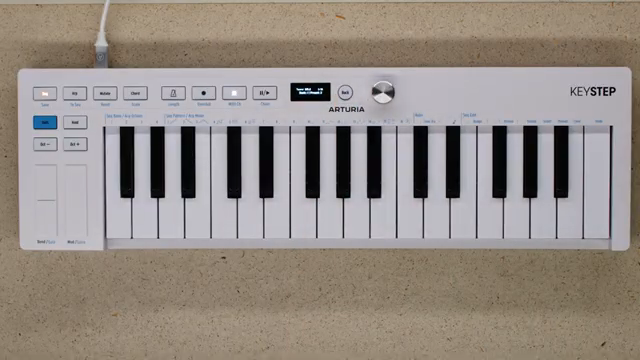
Arturia introduces the KeyStep mk2 as a versatile compact controller and sequencer, designed to serve as the central hub in hybrid hardware–software environments. The video opens with Brendan Void positioning the mk2 as more than just a keyboard, emphasizing its role in bridging DAWs, synths, and modular gear. The focus is clearly on workflow fluidity: the mk2 is pitched as a device that lets you spark ideas, compose, and perform without breaking your creative flow.
From the outset, Arturia’s presentation style is confident and direct, highlighting the mk2’s generative features and its ability to enhance both studio and live setups. The promise is clear—this is a tool built to keep your ideas evolving, whether you’re patching cables or piloting virtual instruments.
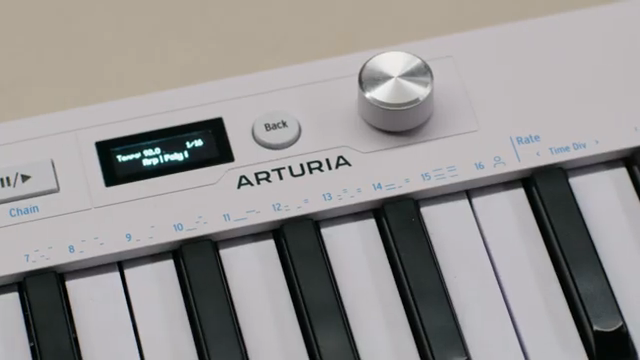
"The KeyStep Mk II is more than just keys, it's a sequencer, arpeggiator, a musical nerve center that bridges hardware and software."
© Screenshot/Quote: Arturiaofficial (YouTube)
Core Features: Keys, Sequencer, and Connectivity
The KeyStep mk2’s front panel is densely packed, but logically laid out for quick access to its main functions. The 32-note slim-key keyboard offers 2.5 octaves, with blue-labeled shift functions above the keys for deep control over sequences, arpeggios, and editing. The top row of buttons provides direct entry to the sequencer, arpeggiator, mutate, and chord modes, while a small OLED display centralizes global and mode-specific settings.
The heart of the mk2 is its 8-voice polyphonic sequencer, supporting up to 64 steps and 64 patterns. Both step and real-time recording are demonstrated, with overdub and step editing modes available for flexible sequence creation. The display’s visual metronome aids timing, and pattern management is handled via shift functions for saving, clearing, and chaining. Connectivity is a recurring theme: CV/gate, MIDI DIN, and USB-C are all present, positioning the mk2 as a true hybrid hub.
Mutate, Chord, and Arp: Creative Tools for Evolving Ideas
"Mutate is a unique function that allows you to generate melodies whilst creating variations of your existing sequences or arpeggiator patterns."
© Screenshot/Quote: Arturiaofficial (YouTube)
Arturia leans into generative creativity with the mutate function, which allows for unpredictable or drastic variations of sequences and arpeggiator patterns. The amount of mutation is visually indicated on the display, and the process is reversible—holding shift and mutate resets to the original pattern. Importantly, mutated patterns can be saved as new presets or chained for live performance, making this more than a mere randomizer.
Scale lock and chord mode further expand the mk2’s creative palette. Scale lock ensures mutated or newly recorded notes stay in key, either globally or per pattern. Chord mode lets users program custom chords or select from presets, playable with a single finger, and includes a strum feature for added expressiveness. These features are clearly aimed at speeding up harmonic experimentation and performance workflows.
Sequencer and Arpeggiator: Seamless Integration for Exploration
The arpeggiator on the KeyStep mk2 is robust, offering 16 modes ranging from classic directions to more experimental patterns that introduce silences, note density changes, and even chords. Modes are easily selected via blue-labeled keys, with instant visual feedback on the display. The hold button latches notes for hands-free operation, and octave shifting is available on the fly.
A standout workflow feature is the ability to convert an arpeggio into a sequence with a simple shift+arp command. This blurs the line between sequencing and arpeggiation, allowing users to treat both as parts of a single creative process. The video demonstrates how mutate and arp modes can be combined for endless idea generation, and how detailed settings for both sequencer and arpeggiator are accessible via long-press menus. Editing tools like nudge, octave transpose, double, quantize, reload, clear, and undo round out the performance and compositional toolkit.
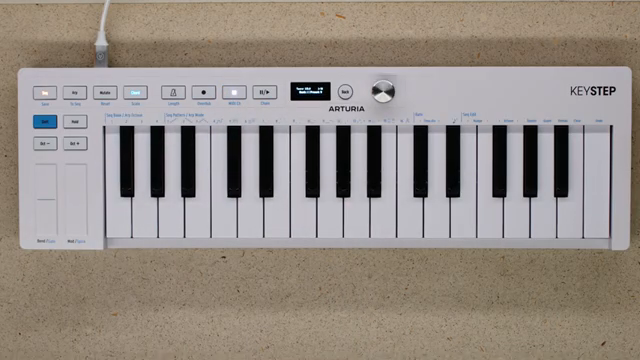
"This truly changes how you can work with the arp and sequencer treating them as one creative tool rather than two separate features."
© Screenshot/Quote: Arturiaofficial (YouTube)
Back Panel: Connectivity for Every Rig
The KeyStep mk2’s back panel is a connectivity playground, designed to integrate with virtually any studio or live rig. It features CV outputs for pitch, gate, and two modulation lanes, as well as sustain input, sync in/out, MIDI in/out, and USB-C for both power and data. An on/off switch rounds out the hardware controls. Arturia’s focus here is on versatility—whether you’re running modular, classic MIDI gear, or DAW-based setups, the mk2 is built to slot in without fuss.
This article is also available in German. Read it here: https://synthmagazin.at/arturia-keystep-mk2-der-hybride-sequencer-controller-der-dein-setup-steuern-will/
Watch on YouTube:
Latest articles
Watch on YouTube:
Visit the channel:
https://www.youtube.com/ArturiaOfficial
https://www.youtube.com/ArturiaOfficial
Links from ArturiaOfficial:
website: https://www.arturia.com
instagram: https://instagram.com/arturia_official
twitter: https://twitter.com/ArturiaOfficial
soundcloud: https://soundcloud.com/arturia-official/albums
Sponsored links:
If you purchase via these links, we may earn a small commission – at no extra cost to you. The link opens an Amazon keyword search, and results may vary depending on availability.
Arturia KeyStep MK2
🔗 Check price on Amazon
🔗 Check price on Amazon