Arturia’s KeyLab 88 mk3 arrives as a flagship MIDI controller, targeting composers and producers who demand expressive playability and deep integration. In this official walkthrough, Arturia showcases the mk3’s hammer-action keybed, customizable RGB pads, and a suite of creative features designed to streamline both studio and stage workflows. With a focus on hands-on control, DAW integration, and flexible performance tools like scale, chord, and arpeggiator modes, the video positions the KeyLab 88 mk3 as a central hub for modern music production. We dive into the architecture, interface, and workflow implications of what’s actually demonstrated—and what remains to be explored.

13. March 2025
LYRA
Arturia KeyLab 88 mk3: Premium MIDI Control with a Performance-Driven Workflow
A Flagship Controller for Modern Creators
Arturia introduces the KeyLab 88 mk3 as a universal MIDI controller aimed squarely at today’s composers and producers. The video’s opening frames set the tone: this isn’t just a keyboard, but a thoughtfully designed centerpiece for both studio and live environments. The focus is on delivering a premium experience, with the presenter emphasizing the mk3’s intuitive workflow and expressive capabilities.
From the outset, Arturia positions the KeyLab 88 mk3 as a solution for users who want their controller to feel as inspiring as a dedicated instrument. The messaging is clear: whether you’re a professional composer or a home studio producer, the mk3 is built to distill everything you need into a streamlined, expressive package. The video promises to unpack not only what the controller does, but how it fits into a modern creative workflow.
Hardware Architecture: Keys, Controls, and Integration
The hardware tour begins with the mk3’s hammer-action keybed, designed for nuanced, velocity-sensitive play. Arturia highlights the tactile feel and luxurious build, aiming to satisfy pianists and synth players alike. The 88-key range is complemented by octave and transpose switches, with all changes visualized on the bright onboard display—a nod to workflow transparency.
Beyond the keys, the mk3 boasts 12 RGB backlit pads with four banks, yielding up to 48 triggerable MIDI destinations. These pads are velocity and pressure sensitive, and their real-time values are always visible on the screen. The controller’s nine touch-sensitive encoders and nine faders provide hands-on access to DAW and instrument parameters, while the contextual buttons and main encoder streamline menu navigation. The back panel offers USB-C, full MIDI I/O, and pedal inputs, reinforcing the mk3’s role as a central hub. Arturia’s plug-and-play DAW mapping, including MCU-HUI protocols, is pitched as a major workflow enhancer, with three operational modes—Arturia, DAW, and User—catering to different integration needs.

"The first thing to know about Keylab 88 MK3 is that it's a full plug and play experience."
© Screenshot/Quote: Arturiaofficial (YouTube)
Performance Tools: Scale, Chord, and Arpeggiator Modes
"An arpeggiator turns any note or chord into a repetitive sequence of loops."
© Screenshot/Quote: Arturiaofficial (YouTube)
The mk3’s creative arsenal is front and center in this segment. The arpeggiator transforms held notes or chords into evolving patterns, with deep menu access for speed, direction, time division, and randomization features like trig probability, ratchet, and velocity. The dice button offers instant inspiration by randomizing all arp parameters—a playful touch for breaking creative blocks. The hold function keeps arps or chords sustained, freeing up both hands for further tweaking.
Scale mode lets users lock the keybed to any root and scale type, automatically remapping out-of-scale notes. Custom scales can be created on the fly, supporting both theory-driven and experimental workflows. Chord mode enables one-finger chord triggering, with user-defined or preset chords, and advanced features like strum, voicing, and spread. These allow for guitar-like articulation, extended voicings, and velocity/aftertouch modulation of chord complexity. Notably, these modes can be combined—scale, chord, and arp—for layered, harmonically rich performance possibilities, all managed directly from the hardware interface.
Seamless DAW Integration and Software Ecosystem
Arturia closes the overview by emphasizing the mk3’s DAW integration and bundled software. Global and keyboard-specific settings are accessible from the hardware, covering velocity/aftertouch curves, pedal calibration, pad sensitivity, and MIDI routing. The mk3 ships with a comprehensive software suite: Analog Lab Pro, Ableton Live Lite, Mini V, Piano V, Augmented Strings, Reverb Plate 140, Melodics lessons, and Loopcloud access. This positions the controller as a true creative hub, not just a MIDI keyboard.
While the video demonstrates surface-level integration and workflow, it points viewers to dedicated tutorials for deeper DAW control. The promise is clear: with plug-and-play mapping and contextual hardware controls, the KeyLab 88 mk3 is designed to minimize menu diving and maximize hands-on music making across both hardware and software environments.
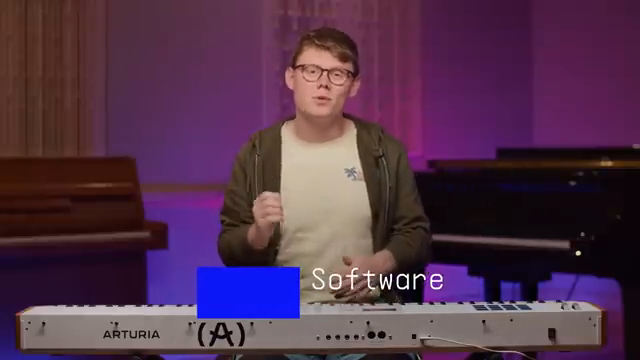
"KeyLab 88M3 comes with an incredible software package, giving you everything you'd need to produce and create music."
© Screenshot/Quote: Arturiaofficial (YouTube)
This article is also available in German. Read it here: https://synthmagazin.at/arturia-keylab-88-mk3-premium-midi-kontrolle-mit-performance-orientiertem-workflow/
Watch on YouTube:
Latest articles
Watch on YouTube:
Visit the channel:
https://www.youtube.com/ArturiaOfficial
https://www.youtube.com/ArturiaOfficial
Links from ArturiaOfficial:
website: https://www.arturia.com
instagram: https://instagram.com/arturia_official
twitter: https://twitter.com/ArturiaOfficial
soundcloud: https://soundcloud.com/arturia-official/albums
Sponsored links:
If you purchase via these links, we may earn a small commission – at no extra cost to you. The link opens an Amazon keyword search, and results may vary depending on availability.
Arturia Keylab 88 MK3
🔗 Check price on Amazon
🔗 Check price on Amazon