Arturia’s AstroLab 37 is pitched as a travel-ready, performance-focused keyboard that distills the company’s celebrated software engines into a portable hardware format. In this official overview, Arturia walks us through the instrument’s curated sound library, hands-on macro controls, and streamlined navigation—all designed for the realities of stage and studio work. With over 1,800 presets, robust effects, and a suite of performance tools, AstroLab 37 aims to bridge the gap between deep synthesis and immediate playability. We examine how this compact keyboard delivers on those promises, and where its workflow strengths truly lie.
26. November 2025
LYRA
Arturia AstroLab 37: Compact Powerhouse for the Modern Stage
AstroLab 37: Software Power in a Portable Shell
Arturia introduces the AstroLab 37 as a compact, expressive stage and studio keyboard, targeting musicians who want the sonic depth of Arturia’s software instruments in a portable, hardware-centric package. The video positions the 37-key model as both affordable and performance-focused, highlighting its suitability for travel, rehearsals, small stages, and tight studio spaces. The core pitch is clear: you get the full sound library of the larger AstroLab models, but in a form factor that’s easy to carry and quick to set up.
AstroLab 37 is presented as a versatile addition to any rig—capable of serving as a dedicated bass, lead, or texture keyboard, or standing alone for more comprehensive duties. Arturia’s approach here is to democratize access to their V Collection engines, making them available in a streamlined, gig-ready device. The emphasis is on immediacy and portability, with the instrument designed to slot seamlessly into both stage and studio workflows.
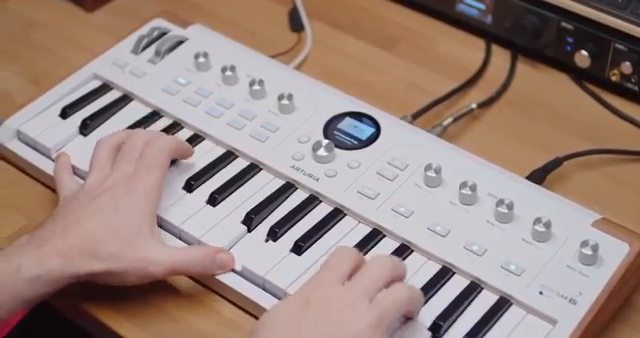
"Astrolab 37 is an avant-garde stage and studio keyboard designed for musicians who want the power of Arturia's software instruments in a compact, affordable and performance-focused hardware format."
© Screenshot/Quote: Arturiaofficial (YouTube)
A Sonic Arsenal: 1,800+ Presets and Hybrid Engines
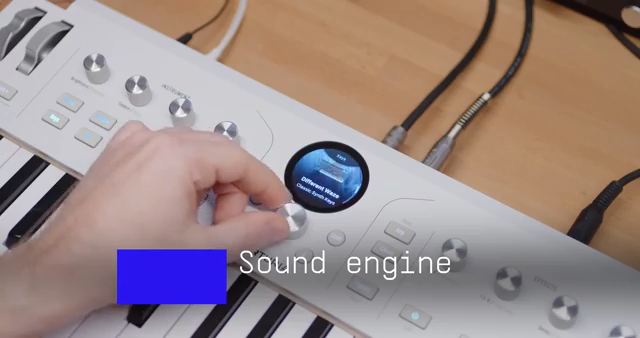
"The sound engine of Astrolab 37 gives you access to a large, curated library of more than 1,800 presets."
© Screenshot/Quote: Arturiaofficial (YouTube)
AstroLab 37’s sound engine is built around a curated library of more than 1,800 presets, spanning a wide range of synthesis techniques. The video underscores that many sounds are inspired by iconic analog and digital classics, while others explore modern approaches like wavetable, FM, and hybrid synthesis. This breadth is demonstrated through a selection of presets, showcasing everything from lush pads and expressive leads to punchy basses and evolving textures.
The instrument is positioned as equally adept at delivering traditional sounds—such as pianos, electric pianos, and organs—as it is at more experimental timbres. Preset switching is described as immediate and performance-friendly, with each sound tailored for musical playability rather than static computer-based editing. The workflow focus is on quick access and musical expressiveness, ensuring that the sound palette is both deep and accessible in live or studio contexts.
Performance Tools: Arpeggiator, Chord, and Scale Modes
AstroLab 37 brings a trio of performance features to the table: arpeggiator, chord mode, and scale mode. The arpeggiator transforms simple chords into rhythmic patterns, with real-time access to direction, octave range, and timing—making it a flexible tool for spontaneous idea generation. Chord mode allows users to trigger full harmonies from a single key, with the ability to record custom chord shapes on the fly, streamlining complex voicings for live play.
Scale mode is designed to lock the keyboard to a chosen scale, ensuring that improvisation stays harmonically grounded and in tune. Together, these features are presented as essential for creating evolving patterns, melodic hooks, and harmonic textures in real time. The workflow here is about reducing barriers to creativity, letting performers move quickly from inspiration to execution without menu-diving or programming detours.
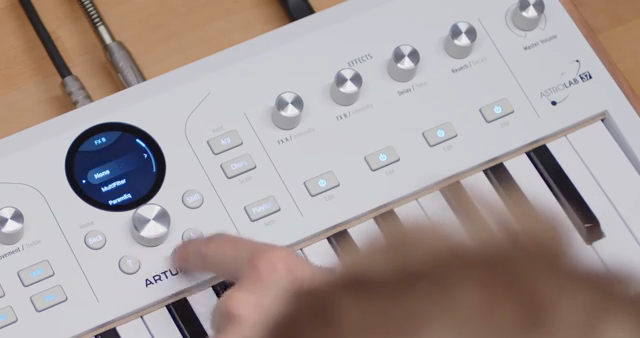
"Astrolab 37 offers three performance modes that help you generate musical ideas at the touch of a button."
© Screenshot/Quote: Arturiaofficial (YouTube)
Navigation: Fast, Focused, and Performance-Ready
Navigation on the AstroLab 37 is engineered for speed and clarity. Instead of a rotary screen knob, the 37-key model employs a high-resolution circular display, a dedicated scroll knob, arrow keys, and a back button. This setup allows users to move through lists, confirm selections, and step through presets or parameters with precision—all without losing focus during a performance.
Browsing is organized by type, instrument, artist, liked presets, sound banks, or playlists, making it easy to jump between categories and find the right sound quickly. The workflow is intentionally streamlined: switching from sound exploration to performance setup is designed to take only moments. Arturia’s navigation philosophy here is about minimizing friction and maximizing immediacy for stage and studio players alike.
Connectivity: Studio and Stage Versatility
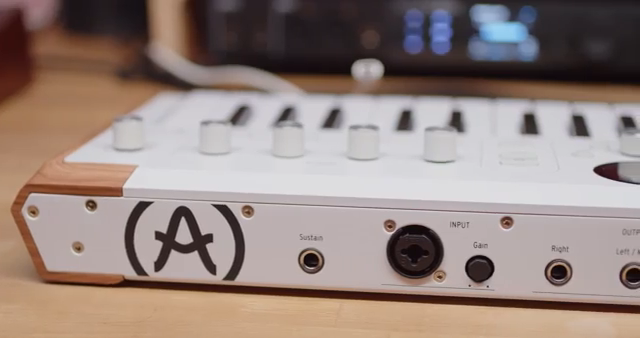
"You'll find MIDI in and out ports, a sustain pedal input, a mono audio input for processing or vocoding external signals, balanced TRS main outputs and a headphone output."
© Screenshot/Quote: Arturiaofficial (YouTube)
AstroLab 37’s connectivity suite is robust, covering both traditional and modern needs. The back panel features MIDI in and out, a sustain pedal input, a mono audio input for processing or vocoding external signals, balanced TRS main outputs, and a headphone output. This ensures compatibility with a wide range of studio and stage setups.
On the digital side, USB-A supports controller power or playlist storage, while USB-C connects the AstroLab 37 to computers or mobile devices. Wireless integration is available via Wi-Fi and Bluetooth, allowing seamless connection with AnalogLab and the AstroLab mobile app. The overall design is about flexibility—whether you’re integrating into a DAW-based studio, a DAWless hardware rig, or a hybrid live setup, the AstroLab 37 aims to slot in without fuss.
This article is also available in German. Read it here: https://synthmagazin.at/arturia-astrolab-37-kompaktes-kraftpaket-fuer-die-moderne-buehne/
Watch on YouTube:
Latest articles
Watch on YouTube:
Visit the channel:
https://www.youtube.com/ArturiaOfficial
https://www.youtube.com/ArturiaOfficial
Links from ArturiaOfficial:
website: https://www.arturia.com
instagram: https://instagram.com/arturia_official
twitter: https://twitter.com/ArturiaOfficial
soundcloud: https://soundcloud.com/arturia-official/albums
Sponsored links:
If you purchase via these links, we may earn a small commission – at no extra cost to you. The link opens an Amazon keyword search, and results may vary depending on availability.
Arturia AstroLab 37
🔗 Check price on Amazon
🔗 Check price on Amazon