When rhythm bends and melody leaps, the soundtrack to K-Pop Demon Hunters becomes more than music—it’s a living, breathing landscape of emotion and narrative. Through Andrew Huang’s luminous lens, we drift through fractured beats and kaleidoscopic hooks, uncovering the soundtrack’s wild, unorthodox spirit. Huang’s signature blend of technical insight and playful curiosity guides us into a world where pop conventions dissolve, and every note feels like a story unfolding in real time. If you crave music that shimmers with surprise and depth, this journey is your invitation to listen with new ears.

A Pop Soundtrack Unmasked
We step into the world of K-Pop Demon Hunters, where the soundtrack’s surface glows with pop perfection but the undercurrents swirl with creative risk. Andrew Huang, ever the sonic explorer, invites us to peel back the immaculate packaging and discover the wild, sometimes unhinged decisions that shape these songs.
This is not a mere breakdown of hooks and drops; it’s an excavation of the choices that make the music breathe. Rhythm, melody, production—each becomes a character in a story that refuses to follow the script. Huang’s analysis promises a journey through the unexpected, where every section reveals a new layer of sonic intent.

"Within its immaculate pop package made such brilliant, creative, weird, and in some cases, I would say unhinged decisions."
© Screenshot/Quote: Andrewhuang (YouTube)
Rhythmic Nebulas: Time Signatures and Pulse
"On an emotional level, it kind of confuses you, makes you perk your ears up a bit."
© Screenshot/Quote: Andrewhuang (YouTube)
The soundtrack’s rhythmic architecture is a shifting nebula, challenging gravity and expectation. In “Golden,” the intro floats untethered from the verse, its pulse ambiguous—counted in threes, sixes, or fours, depending on how you listen. The time signature, often best felt as 12/8, becomes a prism, refracting accents and subdividing the groove into something both familiar and strange.
Huang highlights how these choices pull us off balance, especially when the expected downbeat vanishes in “Your Idol.” Here, the removal of a single beat becomes a moment of disorientation—a sonic ghost that haunts the climax, symbolizing power, loss, or simply the thrill of surprise. These rhythmic maneuvers aren’t just clever; they’re emotional sleights of hand, keeping us suspended between anticipation and release.
Melody as Light: Range and Variation
Melodies in this soundtrack bloom like underwater explosions—wide, unpredictable, and luminous. Huang marvels at the sheer range: in “Golden,” the melody leaps an octave and a fifth, while in “Your Idol,” the pre-chorus stretches across two octaves. These are not melodies designed for comfort; they demand vocal acrobatics and reward with vibrant color.
But it’s not just the range—it’s the constant variation. Hooks return in altered forms, shifting notes and chords, never settling into repetition. Even within a single chorus, the melody evolves, keeping the listener’s ear chasing after new shapes. The result is a sonic landscape that feels alive, each phrase a fresh bloom in a garden of surprises.
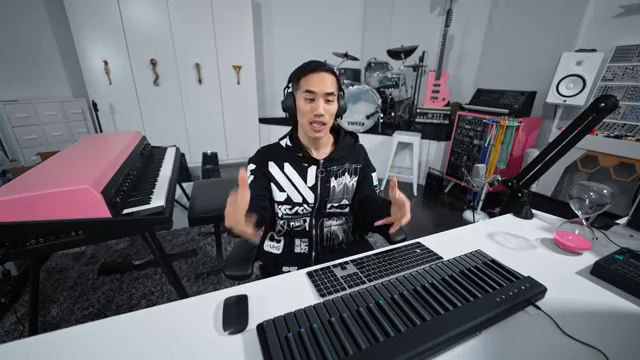
"We're looking at an octave and a fifth range for that melody."
© Screenshot/Quote: Andrewhuang (YouTube)
Unorthodox Arrangements: Narrative in Structure
Arrangement and structure here are not blueprints—they’re living scripts, rewritten in real time. Huang guides us through songs like “How It’s Done” and “Takedown,” where grooves mutate, sections swap places, and the expected verse-chorus-bridge formula is joyfully subverted. Verses split into contrasting halves, pre-choruses build to unexpected destinations, and choruses sometimes appear only twice, defying pop tradition.
This constant evolution mirrors the film’s own narrative pulse. Each structural twist feels like a scene change, a shift in lighting or perspective. The music aligns with the story’s emotional arc, refusing to repeat itself simply for the sake of familiarity. Instead, it pushes forward, always searching for the next moment of resonance.
A Sonic Constellation: Collaboration and Impact
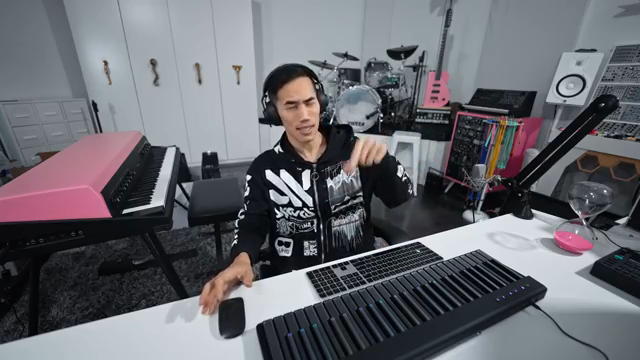
"How much of a songwriting flex is it to come up with an amazing hooky melody and use it one time?"
© Screenshot/Quote: Andrewhuang (YouTube)
The true magic of this soundtrack lies in its collaborative constellation. Huang points to the convergence of top-tier K-pop talent—writers, producers, performers—each bringing their own gravity to the project. The result is a body of work that doesn’t just follow trends; it bends them, forging new paths in songwriting and production.
Writing for film demands development, and here, every song is shaped by the story’s relentless motion. Melodies and hooks appear only once, never to return, echoing the fleeting visuals and shifting emotions onscreen. The soundtrack becomes a living organism, its boundaries dissolving in real time. To truly feel its impact, one must experience the music as Huang does: not as a sequence of parts, but as a story told in sound, full of risk, color, and heart.
This article is also available in German. Read it here: https://synthmagazin.at/andrew-huang-enthuellt-die-klangalchemie-von-k-pop-demon-hunters/
Watch on YouTube:
Latest articles
Watch on YouTube:
Visit the channel:
https://www.youtube.com/andrewhuang
https://www.youtube.com/andrewhuang
Links from andrewhuang:
Instagram: https://instagram.com/andrewismusic
Facebook: https://facebook.com/andrewismusic
Bandcamp: https://andrewhuang.bandcamp.com
My plugin: https://babyaud.io/transit
My book: https://andrewhuang.com/book
My online class: https://studio.com/andrew
Flip Sampler: https://flipsampler.com
Join my Patreon: https://patreon.com/andrewhuang
Join my Discord: https://discord.gg/Fu8zwbFQAa