ALM / Busy Circuits returns with another meticulous deep dive, this time focusing on the Squid Salmple’s prowess with breakbeats. In this fourth instalment, the ALM TV team demonstrates how their 8-channel Eurorack sampler can be wrangled for BPM-syncing, slicing, and time-stretching classic breaks—think Amen and Think—without missing a beat. With the latest firmware introducing a powerful Pitch Parameter, the Squid Salmple is shown as a modular workhorse for creative sample manipulation, all presented in ALM’s trademark hands-on, patch-oriented style. If you’re looking to inject some jungle, DnB, or lofi flair into your rack, this episode is a must-watch for modular heads.
1. March 2025
MILES
ALM TV Breaks Down the Squid Salmple: Sync, Slice & Stretch in Eurorack
Squid Salmple: Modular Sampling Playground
The Squid Salmple is introduced as an 8-channel Eurorack sample player and recorder, purpose-built for modular sampling duties. ALM TV sets the stage by highlighting the module’s evolution through firmware updates, each expanding its creative potential. The focus here is on breakbeat manipulation, with the Squid positioned as a flexible tool for anyone wanting to mangle loops and samples within a modular context.
From the outset, it’s clear that the Squid Salmple isn’t just about playback—it’s about hands-on control and deep integration with other modules. The video promises a look at BPM syncing, slicing, and the new Pitch Parameter, all of which open up new avenues for rhythmic and textural experimentation. For those who like their sampling with a side of voltage control, this is a module that rewards curiosity and patch cable excess.
BPM Syncing: Locking Breaks to the Modular Grid
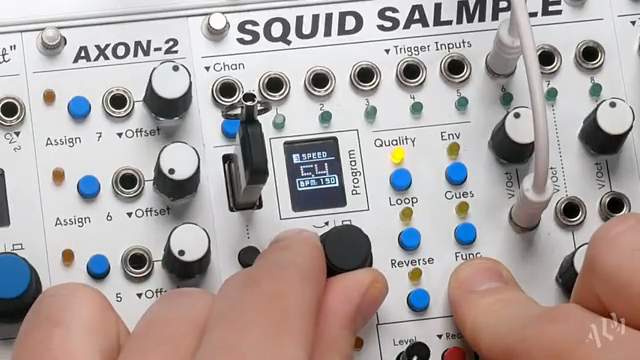
The first demonstration dives into BPM syncing, a crucial technique for modular breakbeat work. By loading a one-bar Amen break into channel 3, ALM TV shows how adjusting the speed parameter alters both playback speed and pitch—classic sampler behaviour. However, the Squid’s new Pitch Parameter allows for pitch shifting without affecting tempo, a nod to more advanced sample engines.
Syncing is made straightforward: holding the function button while adjusting speed reveals a BPM indicator, letting users dial in precise loop tempos. The video illustrates how easily the Squid Salmple can be clocked from Pamela’s Pro Workout, ensuring tight rhythmic alignment. Layering additional one-shots becomes trivial once the break is locked in, and the Pitch Parameter can then be used to shift the break’s character without derailing the groove. The workflow is fast, tactile, and designed for live tweaking.
"By holding function while adjusting the speed setting, a small BPM indicator will appear on the screen, allowing us to determine a specific BPM for the loop."
© Screenshot/Quote: Busycircuits (YouTube)
Pitch Parameter: Decoupling Speed and Tone
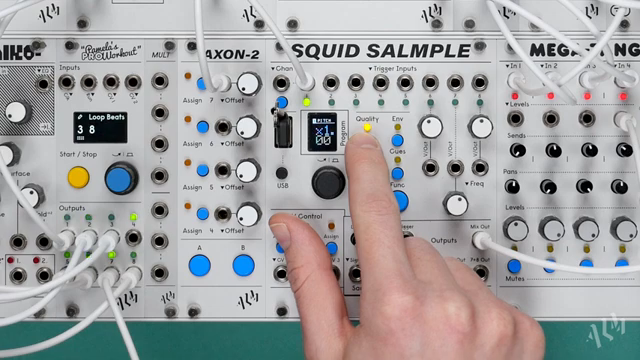
"The new Pitch Parameter allows sample pitch to be set independently of speed for time stretching, exciting pitch shifting effects and more."
© Screenshot/Quote: Busycircuits (YouTube)
A highlight of the latest firmware is the Pitch Parameter, which decouples pitch from playback speed. This addition transforms the Squid Salmple from a basic sample player into a much more creative device. Users can now shift the pitch of a looped break up or down while keeping its tempo locked, allowing for everything from subtle tuning adjustments to wild, formant-shifting effects.
ALM TV demonstrates the utility of this feature both as a simple pitch shifter and as a source of more extreme timbral changes. When combined with filtering or layered with other samples, the Pitch Parameter becomes a powerful tool for sculpting unique textures. The video underscores how this function can be used musically—whether thickening up a track or sending a break into uncharted sonic territory.
Slicing & Sequencing: Granular Break Control
The next section explores slicing and sequencing, giving users granular control over their break samples. By entering the Qsets page, the Squid Salmple allows for rapid subdivision of a sample into multiple segments—16 slices in the demo—each of which can be triggered and sequenced independently. This opens the door to intricate beat rearrangements and step-based sequencing.
The workflow is flexible: slices (Qsets) can be played back in order, at random, or sequenced via CV using expanders like the Axon 2. The video shows how external sequencers or LFOs can modulate slice selection, resulting in evolving, non-repetitive break patterns. The ability to edit start and end points for each slice independently means users aren’t locked into rigid divisions, encouraging creative sample mangling and live improvisation.
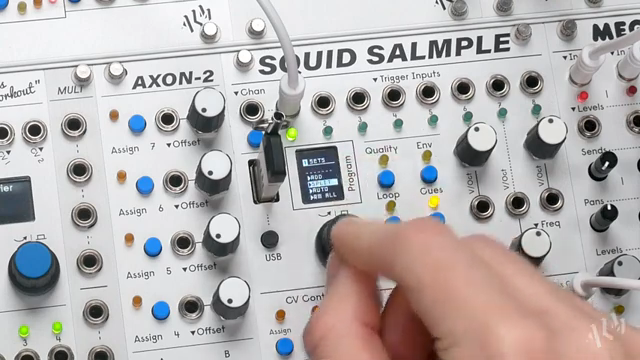
"Let's press Split 4 times to quickly subdivide our sample into 16 equal sized Qsets spaced evenly across the sample."
© Screenshot/Quote: Busycircuits (YouTube)
Time Stretching: Half-Speed Breaks and Beyond
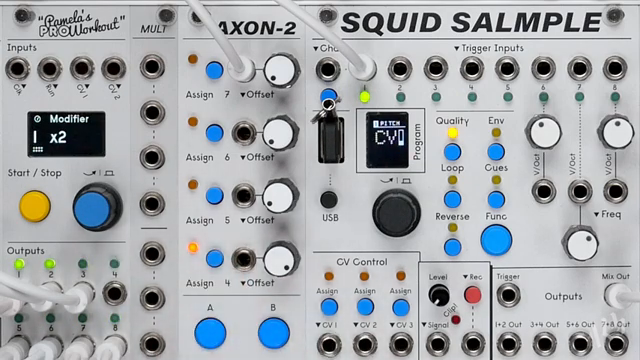
"We can now use the Axon knob to easily shift the break into half speed without altering its pitch, producing a classic time stretch break effect."
© Screenshot/Quote: Busycircuits (YouTube)
The final patch showcases time stretching, a classic sampler trick now made modular-friendly. By manipulating both the speed and pitch parameters—often via CV—the Squid Salmple can drop a break to half speed while maintaining its original pitch. This is achieved by careful offset and attenuation settings, allowing for smooth or abrupt transitions between normal and stretched playback.
ALM TV demonstrates how gates and probability can be used to jump between playback states, making it easy to inject variety into a live set or sequence. The result is a convincing time-stretch effect reminiscent of vintage samplers, but with the immediacy and voltage control that modular users crave. The video wraps up by encouraging users to update their firmware and experiment with these techniques, hinting at the Squid’s potential as a centrepiece for creative sample manipulation in any Eurorack system.
This article is also available in German. Read it here: https://synthmagazin.at/alm-tv-zerlegt-den-squid-salmple-sync-slice-stretch-im-eurorack/
Watch on YouTube:
Latest articles
Watch on YouTube:
Visit the channel:
https://www.youtube.com/busycircuits
https://www.youtube.com/busycircuits
Links from busycircuits:
website: https://busycircuits.com
instagram: https://instagram.com/busycircuits
soundcloud: https://soundcloud.com/busycircuits
Sponsored links:
If you purchase via these links, we may earn a small commission – at no extra cost to you. The link opens an Amazon keyword search, and results may vary depending on availability.
Axon 2 Expander
🔗 Check price on Amazon
🔗 Check price on Amazon
Pamela's Pro Workout
🔗 Check price on Amazon
🔗 Check price on Amazon
Squid Salmple
🔗 Check price on Amazon
🔗 Check price on Amazon