Make Noise, the Asheville-based champions of experimental modular, return with a deep dive into their new universal synthesizer system. In this video, the team explores the Multimod module and its evolving relationship with Polimaths and QXG, revealing how firmware updates and clever cycling modes open up a world of modulation possibilities. Expect a patch-oriented walkthrough, a look at the new USB update process, and a taste of how these modules interact to create complex, stereo-rich soundscapes. It’s classic Make Noise: exploratory, a bit eccentric, and always focused on what happens when you let the patch cables lead the way.

Meet Multimod: The Universal Synthesizer’s New Nerve Centre
The Multimod module is introduced as the first piece of Make Noise’s new universal synthesizer system, designed to play nicely with both Collymaths and QXG. This isn’t just another utility box; it’s positioned as a central hub for modulation and control, reflecting Make Noise’s fondness for modules that encourage open-ended patching and creative exploration.
From the outset, the video frames Multimod as a companion to Collymaths, with its development closely intertwined. The team admits that, during early design, many specifics were still in flux—a classic Make Noise approach, building tools for sonic discovery rather than following a strict blueprint. The channel index output, a key feature, was always intended to bridge Multimod and Collymaths, enabling advanced parameter control across the system.

"it's a great friend to collymaths and QXG."
© Screenshot/Quote: Maken0Isemusic (YouTube)
Firmware, USB and Evolving Outputs: Multimod’s New Tricks
"If we hold reset and press shape, then we select between zero to 10 volt plus or minus five volt and zero to five volt shapes."
© Screenshot/Quote: Maken0Isemusic (YouTube)
The video spotlights the latest Multimod firmware update, which brings the channel index output in line with the emerging standard for Polimaths and related modules. Updating is straightforward: a USB-C data cable connects Multimod to your computer, and a web-based tool handles the rest. This is a welcome nod to modern modular workflows, where firmware tweaks can radically expand a module’s role in a rack.
Beyond the update process, the new firmware introduces selectable output ranges for Multimod’s internal LFOs. By holding reset and pressing shape, users can toggle between 0–10V, ±5V, and 0–5V outputs. This flexibility is especially handy when modulating bipolar parameters like Polimaths’ spread, and the video demonstrates how these voltage ranges interact with the module’s attenuverters for nuanced control.
Cycling Modes: From Maths to Polimaths and Beyond
Cycling functions are a Make Noise staple, and here the Polimaths module takes the concept further. Regular cycling mode works much like on Maths: each channel re-triggers itself at the end of its fall stage, but with Polimaths, this happens across eight channels simultaneously. The result is a dense web of interlocking envelopes or LFOs, ripe for complex modulation duties.
The video then introduces the follow-the-leader mode, accessed by a long press on the cycle button. In this mode, when one channel completes its fall phase, it triggers the next channel in sequence, creating a chain of functions. This opens up possibilities for cascading modulations and evolving rhythmic patterns, especially when multiple chains run in parallel.
There’s a practical note: chains only pause if the next channel is still in its rise phase when triggered. This subtlety allows for intricate timing interactions, making Polimaths a playground for anyone who enjoys building generative or algorithmic patches.
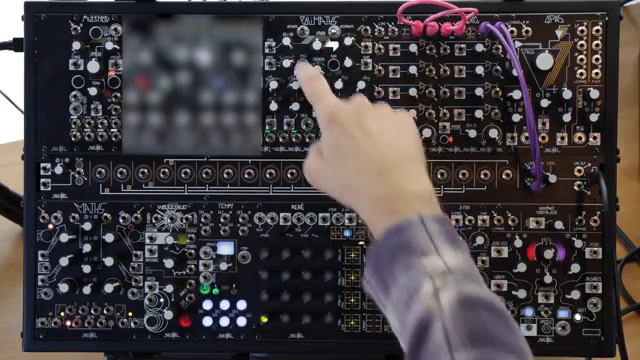
"Here, each time a function gets to the end of its fall phase, instead of reactivating itself, it activates the next channel, creating a chain of functions."
© Screenshot/Quote: Maken0Isemusic (YouTube)
Modulation in Action: Multimod and Polimaths Patchwork
The demonstration shifts to hands-on patching, showing how Multimod and Polimaths interact in a real-world context. An attenuated cycling output from Maths is first patched directly into Polimaths’ span input, revealing how incoming CV selectively activates channels. Adjusting the attenuation changes the number of active channels, and the video highlights the benefits of attenuating at the source for precise control.
Routing the signal through Multimod adds another layer: setting the read shape to stepped random allows random selection of channels within the attenuated range. The patcher demonstrates how inverting the signal flips activation from left-to-right to right-to-left, and how the distribution of active channels can be shaped by the function curve (linear, exponential, logarithmic) of the incoming modulation. The result is a flexible system for targeted, evolving modulation across Polimaths’ many destinations.
Stereo Spread and Community Collaboration: The Broader Picture

"no channel will be hard panned."
© Screenshot/Quote: Maken0Isemusic (YouTube)
The final section explores how these tools can be used for stereo imaging and more ambitious multi-channel setups. With QXG’s X spread controls, Polimaths channels map neatly across the stereo field, allowing for patches that start heavily weighted to one side and bloom across the panorama as cycle chains are triggered. Adjusting the spread controls enables anything from hard-panned to evenly distributed outputs, giving the patcher fine control over spatial placement.
In true Make Noise fashion, the video closes by inviting the community to dive deeper—whether by asking questions about Polimaths’ more esoteric features or by joining the ongoing 12 String Iterative Music Project. The emphasis is on experimentation, collaboration, and the joy of discovering new sonic territory together.
This article is also available in German. Read it here: https://synthmagazin.at/all-the-cycles-make-noise-multimod-polimaths-und-die-kunst-der-modular-modulation/
Watch on YouTube:
Latest articles
Watch on YouTube:
Visit the channel:
https://www.youtube.com/MAKEN0ISEMUSIC
https://www.youtube.com/MAKEN0ISEMUSIC
Links from MAKEN0ISEMUSIC:
website: https://www.makenoisemusic.com
instagram: https://www.instagram.com/makenoisemusic
twitter: https://twitter.com/makenoisemusic
facebook: https://www.facebook.com/makenoiseco
Sponsored links:
If you purchase via these links, we may earn a small commission – at no extra cost to you. The link opens an Amazon keyword search, and results may vary depending on availability.
Maths
🔗 Check price on Amazon
🔗 Check price on Amazon
Multimod
🔗 Check price on Amazon
🔗 Check price on Amazon
PoliMATHS
🔗 Check price on Amazon
🔗 Check price on Amazon